Korea’s Exports to China Jump 113.8% in the First 20 Days of September — Total Exports Hit a Record $71.4bn
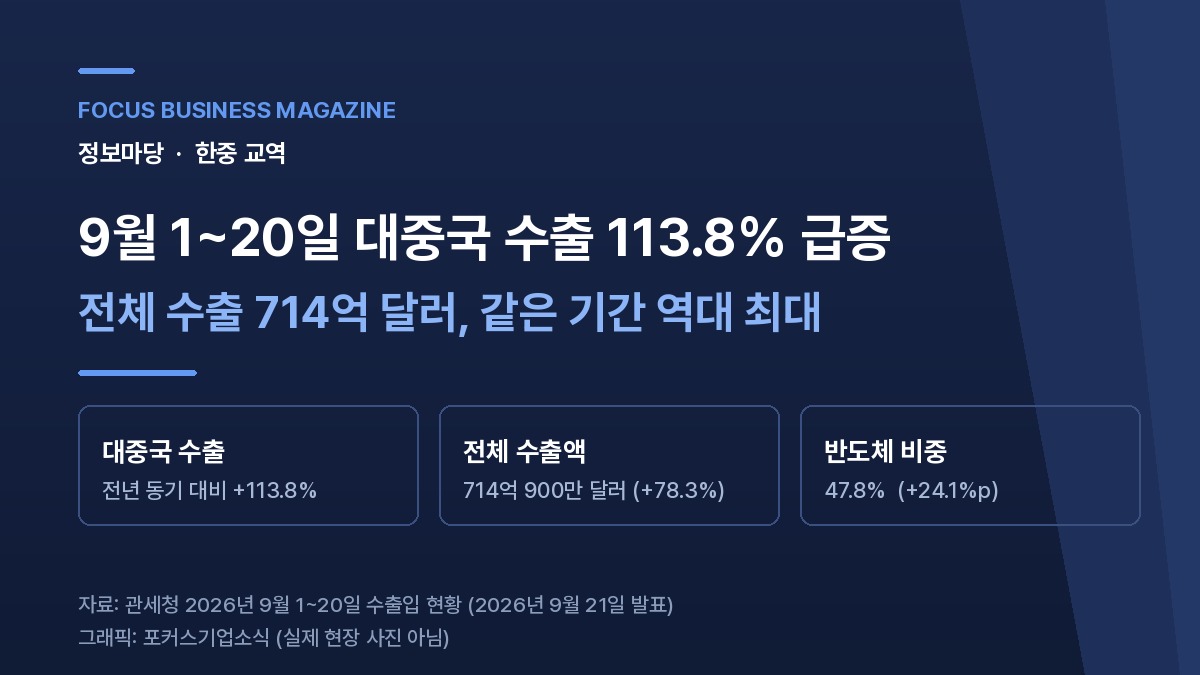
According to the Korea Customs Service release of 21 September, exports for 1–20 September 2026 came to $71.409bn on a customs-clearance basis (provisional), up 78.3% from a year earlier and the highest figure ever recorded for that window. By destination, exports to China rose 113.8%, placing China among the strongest gainers alongside the United States (118.0%) and Taiwan (128.5%). Here is what the numbers mean for Korean businesses operating in China.
The numbers first
Exports for 1–20 September reached $71.409bn, up 78.3% year on year. Even with one fewer working day than a year earlier, average daily exports rose 89.8% to $4.61bn. Cumulative exports for the year stand at $764.997bn, up 55.0%.
Imports over the same period came to $48.443bn, up 26.7%, leaving a trade surplus of $22.966bn. The cumulative surplus for the year is $225.590bn.
Notably, Korea’s exports so far this year have already passed last year’s full-year total of $709.3bn. The Ministry of Trade, Industry and Energy expects exports to reach $1 trillion this year if the current pace holds. As Aju Business Daily notes, only three countries — the United States, China and Germany — have crossed that mark.
Korea’s trade, 1–20 September 2026 (Korea Customs Service, provisional, customs-clearance basis)
- Exports
- $71.409bn · +78.3% year on year (a record for the 1–20 window)
- Average daily exports
- $4.61bn · +89.8% (one fewer working day)
- Imports
- $48.443bn · +26.7%
- Trade balance
- $22.966bn surplus
- Year to date
- Exports $764.997bn (+55.0%) · imports $539.407bn (+19.5%) · surplus $225.590bn
- Exports to China
- +113.8%
- Imports from China
- +48.7%
- Semiconductor exports
- $34.128bn · +259.4% · 47.8% of all exports (up 24.1 percentage points year on year)
China remains the largest partner
All ten major destinations posted gains: China (113.8%), the United States (118.0%), Vietnam (44.8%), Taiwan (128.5%) and the European Union (37.0%). China, the United States and Vietnam together account for 51.4% of total exports.
On the import side, shipments from China rose 48.7%. Imports from the United States (29.5%), Japan (31.6%), Taiwan (76.9%) and the EU (16.7%) also grew, while imports from Australia (−13.7%) and Saudi Arabia (−22.7%) fell.
Following this magazine’s earlier coverage of August exports to China ($24.1bn, up 119.3%) and China’s August trade data (imports from Korea up 108%), the expansion in Korea–China trade has clearly carried into mid-September.
A mixed picture by product
Semiconductors drove the gain. Semiconductor exports for 1–20 September came to $34.128bn, up 259.4%, lifting the sector’s share of total exports to 47.8% — 24.1 percentage points higher than a year earlier. Higher oil prices pushed petroleum product exports up 47.8%, and ships (63.0%), computer peripherals (187.6%), passenger cars (9.3%) and steel products (8.0%) also rose.
Others went the other way. Wireless communication devices slipped 0.4% to $1.245bn, while auto parts (−6.3%), precision instruments (−6.3%) and home appliances (−6.7%) all declined. For companies in China handling components, materials or consumer goods, this is where the gap between the “record exports” headline and their own order book becomes visible.
Among imports, semiconductors rose 88.8% to $8.742bn, with semiconductor manufacturing equipment up 55.6% and machinery up 5.4%. Energy imports rose 27.9%: crude oil $5.798bn (+37.3%), gas $2.003bn (+16.4%) and coal $846m (+4.0%). Petroleum product imports fell 24.8% to $1.092bn.
Three things for Korean businesses in China
First, the boom is narrow. A single product category accounts for nearly half of all exports. Sectors with no direct link to semiconductors — auto parts, home appliances, precision instruments — actually contracted over the same period. Before building next year’s plan on the headline figure, it is safer to check the trend in your own category separately.
Second, Korea–China trade is expanding in both directions. Exports to China rose 113.8%, but imports from China also rose 48.7%. Volumes are growing both for sourcing in China and shipping to Korea, and for taking material from Korea to process in China. Customs and logistics lead times, and inventory turnover plans, are worth recalculating at current volumes.
Third, the external variable lands this week. China’s Ministry of Foreign Affairs announced on 21 September that President Xi Jinping will make a state visit to the United States on 23–25 September, with a summit in Washington on the 24th. Tariffs and a possible extension of the suspension of rare-earth export controls are among the expected agenda items. Strong bilateral trade numbers do not insulate supply-chain terms from the outcome of those talks; leaving room to adjust afterwards is the safer posture.
Note that these figures are provisional customs-clearance data. Confirmed monthly figures will follow in the end-of-month releases from the Korea Customs Service and the Ministry of Trade, Industry and Energy.
Sources
- Source report
- Aju Business Daily, ‘Exports up 78.3% through mid-September, a fresh record — semiconductors up 259.4%’ (21 Sep 2026, by Kim Sung-seo)
- Source report
- Money Today, ‘Exports of $71.4bn for 1–20 September, an all-time high — semiconductors up 259.4%’ (21 Sep 2026)
- Primary data
- Korea Customs Service, ‘Exports and imports, 1–20 September 2026’ (released 21 Sep 2026, provisional, customs-clearance basis)
- Related
- Aju Business Daily, ‘China confirms Xi Jinping’s 23–25 September visit to the US — tariffs and rare-earth control suspension on the agenda’ (21 Sep 2026)
- See also
- August exports to China reach $24.1bn, up 119.3% in a year · China’s August trade data — imports from Korea up 108%
※ This article is an automatically generated draft based on reporting by Aju Business Daily and Money Today (21 September 2026) and Korea Customs Service data. Editorial review is required before publication.
← Back to the list