China’s August trade data — imports from Korea jump 108%, surplus widens to $119.1 billion, and trade-friction risk grows
China’s General Administration of Customs reported on 8 September that August exports rose 25.0% year on year to $401.4 billion, while imports climbed 28.2% to $282.4 billion. The trade surplus widened from July to $119.1 billion. The standout figure for Korea: China’s imports from Korea more than doubled to $32.16 billion (+108.1%), and its exports to Korea rose 49.3% to $18.01 billion. At the same time, a larger surplus with the United States and renewed claims that the yuan is undervalued are adding a new variable — trade friction originating from China.
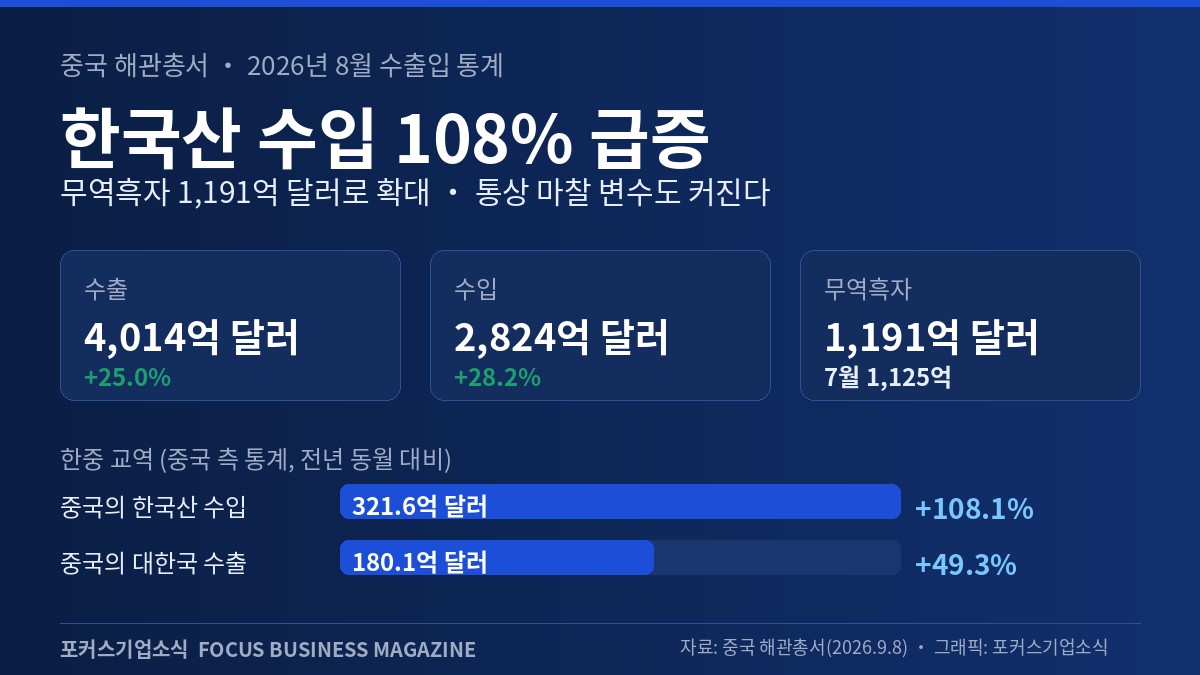
The 25.0% export growth matched the market forecast compiled by Reuters and topped July’s 23.9%. Import growth of 28.2% fell short of the 30.0% forecast but exceeded July’s 27.5%. The August surplus of $119.09 billion was up from $112.5 billion in July, bringing the January–August cumulative surplus to $805.51 billion.
Exports were driven by AI-related products and advanced manufactured goods such as electric vehicles, solar cells and lithium-ion batteries. Xing Zhaopeng, senior China strategist at ANZ, told Reuters that “demand for AI products, EVs, solar cells and lithium-ion batteries offset the negative impact of bad weather.” Firms also continued to front-load shipments to the United States amid tariff uncertainty.
China’s August 2026 trade at a glance (China Customs, USD)
- Exports
- $401.44 billion (+25.0%) · July +23.9%; in line with forecast
- Imports
- $282.36 billion (+28.2%) · July +27.5%; below 30.0% forecast
- Trade surplus
- $119.09 billion (July $112.5 billion) · Jan–Aug cumulative $805.51 billion
- Imports from Korea
- $32.16 billion (+108.1%)
- Exports to Korea
- $18.01 billion (+49.3%)
- Exports to / imports from US
- $42.48 billion (+34.4%) / $13.29 billion (+17.8%) · US surplus about $29.18 billion (July $28.0 billion)
- Exports to EU
- +6.6%
- Crude oil imports
- 37.93 million tonnes · +6.2% m/m, -23.4% y/y · Jan–Aug -14.6%
- Rare-earth exports
- 4,735.1 t (+12.1% m/m), $73.5 million (+42.1%) · Jan–Aug volume -11.1%, value +53.5%
- Released
- General Administration of Customs of China, 8 September 2026
Imports from Korea up 108% — a sign of recovering chip and component demand
For Korea, the number that matters most is China’s imports from Korea: $32.1575 billion in August, up 108.1% from a year earlier. China’s exports to Korea rose 49.3% to $18.0114 billion. On China Customs figures, China ran a deficit of roughly $14.15 billion with Korea in August — a surplus of the same size from Korea’s point of view.
Industry watchers read the surge as a signal that demand for semiconductors and electronic components is recovering on the back of global AI investment. China is the main production base for smartphones, servers and data-centre equipment, so when Chinese output and exports rise, demand for Korean memory chips, displays and components rises with them. But a country-level import total alone cannot show whether the increase came from high-bandwidth memory (HBM) or advanced DRAM. Higher chip prices, base effects and larger imports of commodity memory and other intermediate goods may all have played a part, so volumes and unit prices need to be checked item by item.
Korea says $24.1 billion, China says $32.16 billion — why the gap
Korea’s Ministry of Trade, Industry and Resources reported on 1 September that exports to China reached $24.10 billion in August (+119.3%). That is more than $8 billion below China’s figure for imports from Korea. Neither side is wrong; the methods differ. Exports are usually recorded free on board (FOB), excluding freight and insurance, while imports are recorded cost, insurance and freight (CIF). Countries also classify origin and final destination differently for goods routed through Hong Kong and other third places. This is why the two governments’ bilateral balances never quite match. The direction — a sharp jump — is the same in both datasets, but when comparing absolute amounts it is worth confirming whose statistics are being cited.
A wider US surplus and yuan-undervaluation claims — the trade-friction variable
China’s exports to the United States rose 34.4% to $42.4753 billion in August, while imports from the US increased 17.8% to $13.2927 billion. The bilateral surplus widened to about $29.18 billion from $28.0 billion in July. Exports to the EU grew 6.6%.
As the surplus balloons, criticism that the yuan is excessively undervalued is intensifying, mainly in Western capitals. According to Korea’s Financial News, Brad Setser, senior fellow at the Council on Foreign Relations, estimates the yuan is undervalued by roughly 20%. At the recent G20 finance ministers’ meeting, a joint statement aimed at countries that rely excessively on exports was issued, and China alone declined to sign. People’s Bank of China Governor Pan Gongsheng countered that “China has never deliberately pursued a trade surplus or devalued its currency for competitiveness.”
The surge in US-bound exports demonstrates Chinese manufacturing’s price and supply competitiveness, but it could also strengthen calls in the US for higher tariffs or import restrictions on Chinese goods. Reuters assessed that China’s reliance on exports to absorb production capacity is increasing its exposure to regulatory action by trading partners such as the US and EU. Analysts nonetheless expect leader-level diplomacy, including President Xi Jinping’s visit to the United States scheduled this month, to proceed despite the currency dispute.
Strong exports alongside weak domestic demand
Double-digit growth in both exports and imports does not mean China’s domestic demand has fully recovered. Crude oil imports of 37.928 million tonnes in August were up 6.2% from July but down 23.4% from a year earlier, and down 14.6% for January–August. EV adoption and refiners’ inventory management are part of the story, but markets also see it as a sign that traditional domestic sectors such as property and construction are recovering more slowly than advanced manufacturing. Zhang Zhiwei, president and chief economist at Pinpoint Asset Management, said that “China continues to rely on exporters to support the economy.”
China’s GDP growth slowed to 4.3% in the second quarter. To reach this year’s 4.5–5.0% target, the government is stepping up fiscal spending, including a $54 billion capital injection into state banks and insurers. Markets expect the central bank to cut rates once or twice more before year-end.
Rare earths — lower volume, higher value
China exported 4,735.1 tonnes of rare earths in August, up 12.1% from July, with the value up 42.1% to $73.5 million. Yet January–August export volume fell 11.1% to 39,441.4 tonnes while the value rose 53.5%, meaning average prices climbed sharply. Because prices and processing levels vary widely by product, analysts caution against attributing the increase solely to export controls; the mix of higher-value products and international price moves should be considered too. For the EV, battery, defence and electronics industries, the stability of rare-earth supply remains a key variable.
What Korean businesses in China should watch
First, the impact differs by sector. Semiconductors and advanced electronic components can expect stronger demand as China expands production and exports of high-tech goods. Automobiles, batteries, steel and petrochemicals, by contrast, face tougher competition from Chinese rivals. More Chinese commodity steel and petrochemicals on world markets would squeeze international prices and margins and intensify head-to-head competition in third-country markets.
Second, trade friction originating from China also reaches Korean suppliers of parts for Chinese finished goods. If the US or EU imposes additional tariffs or origin rules on Chinese products, orders to component suppliers serving Chinese factories’ US- and Europe-bound output would be affected as well. It is worth checking where your customers’ final export markets are.
Third, the direction of the yuan. Persistent undervaluation claims and an accumulating surplus could add appreciation pressure, while further PBOC rate cuts point the other way. Firms converting yuan revenue into won or dollars, or importing raw materials from Korea, would be wise to build the possibility of wider exchange-rate swings into their settlement terms.
The data sends a positive near-term signal to Korea’s chip and advanced-component makers, but markets say China dependence and trade risk must be managed together over the longer run. Serving Chinese demand while diversifying production and sales networks toward the US, Southeast Asia and India is likely to grow in importance.
Sources
- Primary data
- General Administration of Customs of China, August 2026 trade statistics (2026-09-08)
- Original report
- Korea Post (Korean edition), ‘China’s August exports up 25%… imports from Korea surge 108%, lifting chip-recovery hopes’ (2026-09-08)
- Original report
- Financial News, ‘China’s August exports surge 25%… trade pressure mounts amid weak domestic demand’ (2026-09-08)
- Korean statistics
- Ministry of Trade, Industry and Resources, ‘August 2026 Import-Export Trends’ (2026-09-01) · Related: Korea’s exports to China hit $24.1 billion in August, up 119.3%
※ This article was auto-drafted based on reporting by Korea Post (Korean edition) and Financial News (2026-09-08). Editorial verification is required before publication.
← Back to list