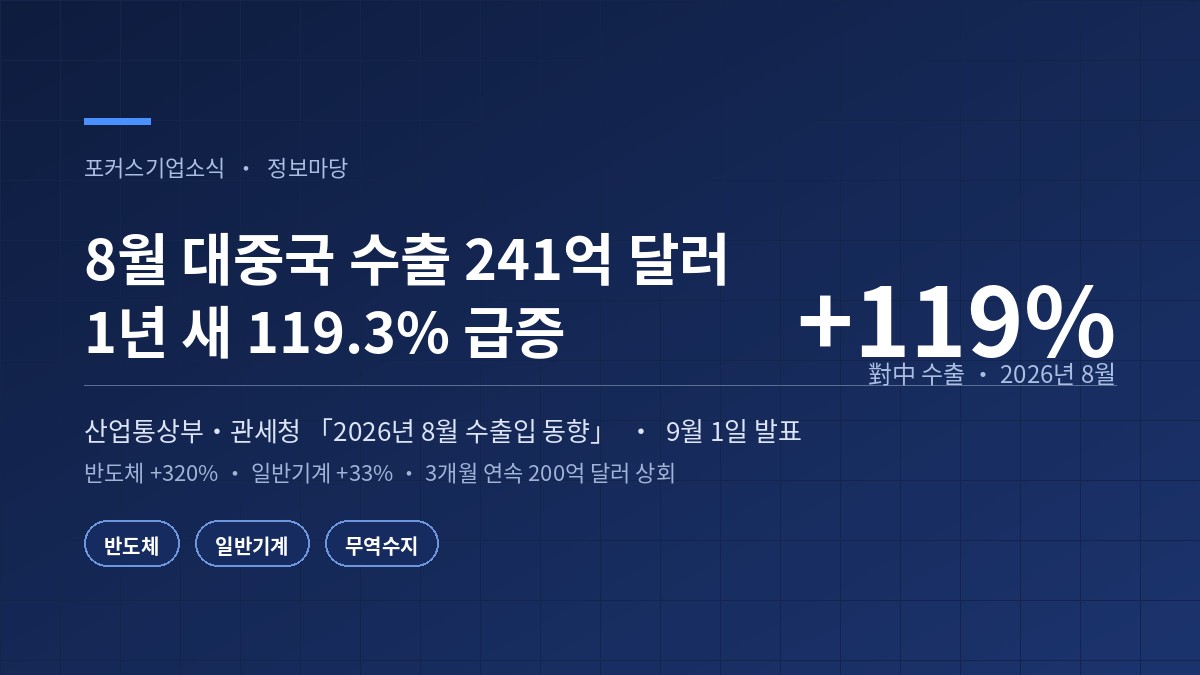
Korea's exports to China hit $24.1 billion in August, up 119.3%
Korea's exports to China reached $24.1 billion in August, up 119.3% from a year earlier, according to the August trade report released on September 1 by the Ministry of Trade, Industry and Energy and the Korea Customs Service. Semiconductor shipments more than tripled and general machinery rose 33%, keeping China-bound exports above $20 billion for a third consecutive month. Total exports rose 68.7% to $98.25 billion, and the trade surplus came to $34.75 billion.
Korea's exports grew nearly 70% year on year in August, topping $90 billion for a third straight month. The August trade report, released September 1 by the Ministry of Trade, Industry and Energy and the Korea Customs Service, put exports at $98.255 billion, up 68.7% from a year earlier. It was the 15th consecutive month of growth and the third-highest monthly total on record. Average daily exports, adjusted for working days, rose 72.5% to $4.47 billion.
China-bound exports $24.1 billion, chips more than triple
By destination, China posted the steepest gain. Exports to China rose 119.3% to $24.1 billion, staying above $20 billion for a third consecutive month. Petrochemicals, wireless devices and displays were weak, but semiconductors surged 320% and general machinery rose 33%, lifting the overall figure.
Exports to the United States rose 89.3% to $16.5 billion, with semiconductors up 300% and computers up 1,040%; steel and petroleum products were also strong.
Korea's August 2026 trade (MOTIE / Korea Customs Service, released Sep 1)
- Total exports
- $98.255 billion (+68.7% y/y, 15th straight month of growth, third-highest on record)
- Exports to China
- $24.1 billion (+119.3%, above $20 billion for 3 straight months) · chips +320%, general machinery +33%
- Exports to the U.S.
- $16.5 billion (+89.3%)
- Semiconductor exports
- $46.65 billion (+209.0%, monthly record, above $40 billion for 3 straight months)
- Imports
- $63.507 billion (+22.5%)
- Trade balance
- Surplus of $34.748 billion (above $30 billion for 3 straight months)
- Jan–Aug cumulative exports
- $693.318 billion (+52.8%, 97.7% of last year's full-year total)
Chips at $46.65 billion, a monthly record
By product, semiconductor exports rose 209.0% to $46.65 billion, setting a new monthly record and exceeding $40 billion for a third straight month. The ministry cited sustained AI infrastructure demand as hyperscalers such as Google and Amazon expanded capital spending, along with rising contract prices for memory. Semiconductors accounted for 47.5% of all August exports.
Exports excluding semiconductors also rose 20%. Computers (including enterprise SSDs) jumped 419.5% to $6.24 billion, another monthly record. Wireless devices ($1.88 billion, +21.2%), petroleum products ($6.84 billion, +65.3%), petrochemicals ($3.86 billion, +12.2%), rechargeable batteries ($600 million, +24.0%) and steel ($2.11 billion, +7.9%) all grew. Bio-health ($1.41 billion, +22.3%), cosmetics ($1.31 billion, +52.1%) and agri-food ($980 million, +1.5%) each set records for the month of August.
Automobile exports, by contrast, fell 29.8% to $3.85 billion, reflecting a shift in the timing of summer shutdowns at major carmakers and partial strikes at some plants. Ships (-45.9%) and auto parts (-10%) also declined.
Surplus of $34.7 billion; year-to-date exports at 98% of last year
Imports rose 22.5% to $63.507 billion. Energy imports were $12.68 billion (+15.3%) and non-energy imports $50.83 billion (+24.4%). Crude oil volumes fell 3% but unit prices rose 26%, while imports of semiconductor equipment (+117.3%) and non-ferrous metals (+27.6%) increased.
The August trade surplus was $34.748 billion, up $28.345 billion from a year earlier and above $30 billion for a third straight month since June. Cumulative exports for January through August reached $693.318 billion, up 52.8%, already equal to 97.7% of last year's full-year exports of $709.407 billion. The cumulative surplus for the eight months was $202.507 billion.
Trade Minister Kim Jung-kwan said uncertainty in the trading environment was “higher than ever” given U.S. tariff policy, the EU's steel tariff-rate quota, global supply-chain realignment and the situation in the Middle East, adding that the government would not rest on the current export strength and would closely monitor how these changes affect Korean exporters.
What Korean businesses in China should read into this
A 119.3% jump in exports to China is striking, but the breakdown shows it is essentially a one-product story. Categories with closer ties to Korean-run manufacturers and distributors in China, such as petrochemicals, wireless devices and displays, were actually weak. The more accurate reading is not that the Chinese market has recovered, but that AI chip demand is flowing through China-linked supply chains.
For Korean firms in Tianjin and the wider North China region, two points stand out. First, general machinery exports rose 33%, a category tied to Chinese manufacturing capital expenditure and a positive signal for local parts and equipment suppliers. Second, consumer goods such as cosmetics (+52.1%) and agri-food set records for August, which dovetails with KOTRA's recent private-label partnering event with Chinese retailers in Shanghai and other consumer-goods market-entry support.
Note that these figures are Korean customs-clearance export data; China's General Administration of Customs uses different methodology and may report different import figures. For product-level and regional detail, the ministry's original press release is the authoritative source.
References
- Issuing bodies
- Ministry of Trade, Industry and Energy / Korea Customs Service, “August 2026 Import and Export Trends” (released 2026-09-01)
- Source report
- Aju Business Daily, “Semiconductor exports hit record; August exports $98.25 billion, above $90 billion for third month” (2026-09-01)
- Related
- Korea–China FTA services & investment talks resume in Beijing · China's August manufacturing PMI at 49.8
※ This article was auto-drafted based on the MOTIE / Korea Customs Service release and reporting by Aju Business Daily (2026-09-01). Editorial verification is required before publication.
← Back to list