China's August manufacturing PMI at 49.8 — recovery within contraction, and a widening large-vs-small firm gap
China's National Bureau of Statistics reported on 31 August that the country's manufacturing purchasing managers' index (PMI) rose 0.6 points month on month to 49.8 in August. The figure beat market expectations but stayed below the 50 line separating expansion from contraction for a second straight month. Beneath the headline, large firms moved above the threshold while small firms remained at 47.9.
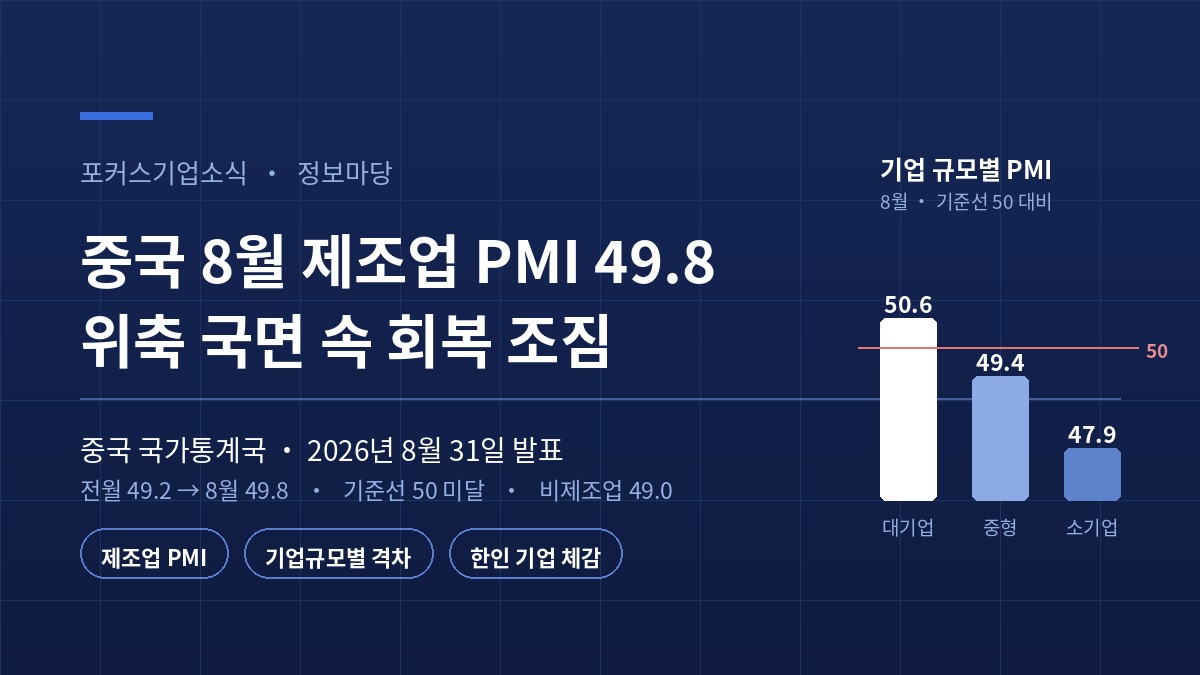
China's manufacturing conditions improved in August but have yet to leave contraction territory. The National Bureau of Statistics said on 31 August that the manufacturing PMI stood at 49.8, up 0.6 points from July's 49.2, which had been a five-month low. The reading also topped the median analyst forecast of 49.5 compiled by Bloomberg.
The PMI is a diffusion index built from surveys of corporate purchasing managers. A reading above 50 signals expansion, below 50 contraction. August's number points upward in direction, but its absolute level remains under the threshold.
China PMI, August 2026
- Manufacturing PMI
- 49.8 (July 49.2, +0.6) · above the 49.5 forecast
- Production index
- 50.4 (+0.5) — in expansion
- New orders index
- 50.6 (+2.1) — in expansion
- By firm size
- Large 50.6 (+1.1) / Medium 49.4 (-0.3) / Small 47.9 (+0.5)
- By sector
- High-tech manufacturing 52.9 (-0.4) / Equipment manufacturing 51.4 (unchanged) / Consumer goods manufacturing 49.0 (+1.2) / High energy-consuming manufacturing 47.9 (+0.9)
- Non-manufacturing PMI
- 49.0 (unchanged) · below the 49.4 forecast
- Construction activity index
- 46.9 (-0.1)
- Services activity index
- 49.3 (unchanged)
- Composite PMI
- 49.5 (July 49.3, +0.2)
- Released
- National Bureau of Statistics of China, 31 August 2026
16 of 21 surveyed sectors improved
The breadth of the improvement was not narrow. Of the 21 sectors surveyed, 16 posted a higher PMI than in July. Among sub-indices, production rose 0.5 points to 50.4 and new orders climbed 2.1 points to 50.6, putting both back in expansion. Production and orders crossing the threshold together is typically read as a sign that demand is beginning to warm.
He Hui, vice chairman of the China Federation of Logistics and Purchasing, said both domestic and overseas demand for manufacturing widened somewhat in August, and credited stronger policy support with lifting growth momentum. Chinese authorities attributed the improvement to the effects of domestic demand expansion policies, a more pronounced guiding role for central budget investment, faster progress on 109 major projects and the "six core networks" construction programme, and steady growth in summer consumption.
Weather was named as the drag. Officials said extreme conditions — high temperatures, typhoons, heavy rain and flooding — constrained manufacturing activity.
Large firms 50.6, small firms 47.9 — same index, different reality
The most notable feature of the release is the gap by firm size. The large-firm PMI rose 1.1 points to 50.6, moving back above the threshold. Medium-sized firms slipped 0.3 points to 49.4. Small firms gained 0.5 points to 47.9, the only one of the three groups still in the 47 range.
Sector readings diverged too. High-tech manufacturing (52.9) and equipment manufacturing (51.4) stayed in expansion, while consumer goods manufacturing rose 1.2 points yet remained below the line at 49.0, and high energy-consuming manufacturing came in at 47.9.
In short, the headline "China's manufacturing improved" can feel very different on the ground depending on a company's size and sector.
Non-manufacturing flat, construction still weak
The non-manufacturing PMI, which covers construction and services, was unchanged at 49.0, missing the 49.4 forecast. With the property market still depressed, the construction business activity index slipped another 0.1 points to 46.9, while the services activity index held at 49.3. The composite PMI combining manufacturing and non-manufacturing rose 0.2 points from July's 49.3 to 49.5.
The National Bureau of Statistics said production and market demand at manufacturers both expanded from the previous month and that the trend toward structural optimisation and upgrading was clear. Bloomberg noted that while the economy remains in contraction, signs of recovery have emerged as policymakers weigh fresh measures.
The PMI path this year
China's manufacturing PMI stayed below 50 for eight consecutive months from April to November last year before rebounding to 50.1 in December. This year it fell back into contraction at 49.3 in January and 49.0 in February, then hit a one-year high of 50.4 in March. It narrowly held the line at 50.3 in April, 50.0 in May and 50.3 in June, dropped to 49.2 in July, and recovered part of that decline at 49.8 in August.
What Korean businesses in China should watch
Most Korean-run businesses in China — Tianjin included — fall into the small and medium-sized bracket, and cluster in consumer goods, distribution, food service and services. In this release, that combination sits entirely below the threshold: small firms 47.9, consumer goods manufacturing 49.0, services activity 49.3, construction 46.9.
The direction, though, is not discouraging. Consumer goods manufacturing posted one of the larger monthly gains at +1.2 points, and the manufacturing new orders index moving into expansion suggests order flow is reviving. Companies supplying parts or materials into manufacturing may want to factor in a possible pickup in fourth-quarter enquiries.
Construction- and property-linked lines of business — interiors, building materials, equipment and related logistics — are a different matter. With the construction index falling further within the 46 range, this is hard to read as recovery. For those sectors, receivables management and customer credit checks may take priority over new investment.
A caveat: the PMI is a sentiment-based diffusion index showing direction, not sales or output itself. A single month's move is not enough to call a turning point, and August's figure includes the temporary effect of extreme weather, as officials themselves noted. Individual business decisions are safer when read alongside actual order flow in your own sector and region.
Sources
- Primary data
- National Bureau of Statistics of China, China Purchasing Managers Index for August 2026 (31 Aug 2026)
- Reporting
- Etoday, "China's August manufacturing PMI 49.8 — recovery within contraction" (31 Aug 2026)
- Reporting
- Asia Economic Daily, "China's August manufacturing PMI in contraction — officials cite extreme weather" (31 Aug 2026)
※ This article was auto-drafted based on reporting by Etoday and Asia Economic Daily (2026-08-31). Editorial verification is required before publication.
← Back to list