Korea–China Chip Supply Chains Grow Closer — Korean Memory Processed in China, Then Re-exported Worldwide
Semiconductors accounted for a record 69.4% of Korea’s exports to China in August. Over the same period, China’s imports of Korean-made memory chips also surged, with Jiangsu province — home to Samsung Electronics’ and SK hynix’s production bases — posting the sharpest rise, above 350%. According to an Economy Times report of 23 September citing a brokerage research note, the volume of Korean-made chips that China imports, processes and re-exports is also growing. Korea and China’s semiconductor ecosystems are more tightly linked than ever.
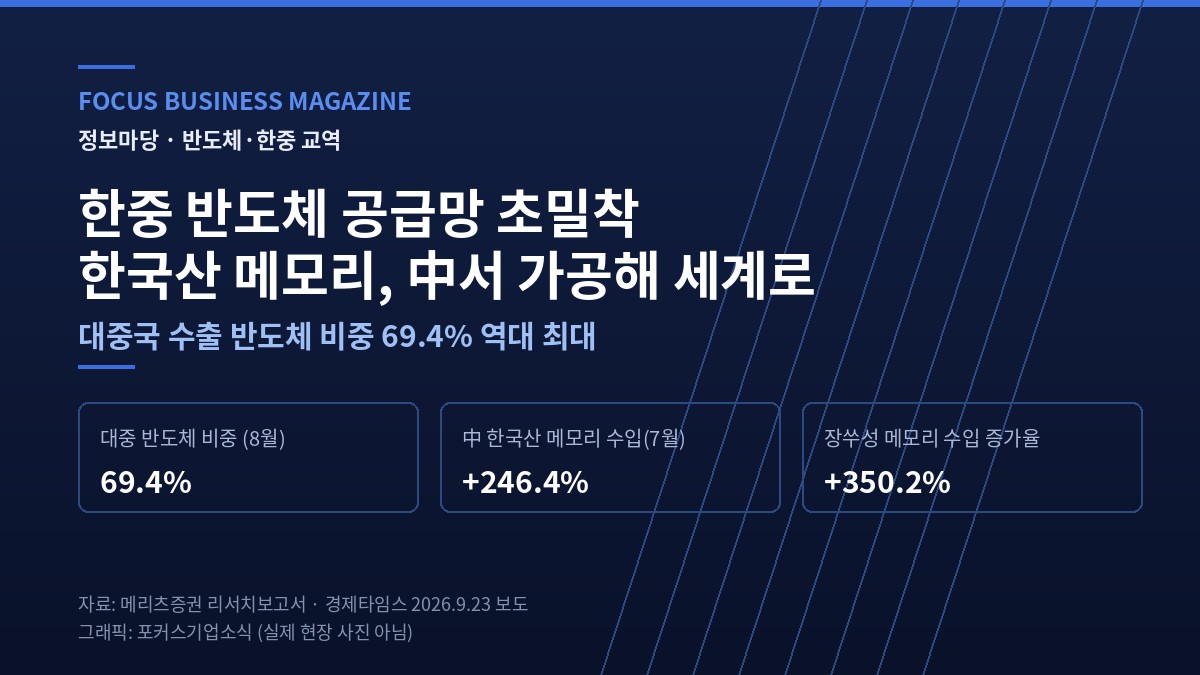
In an article headlined “Korean chips processed and shipped to the world…Korea–China semiconductor ecosystem grows closer,” the Economy Times cited a brokerage research note on 23 September to trace structural change in Korea–China chip trade. Korea Customs Service data released earlier had shown total exports for 1–20 September up 78.3% year on year, with semiconductor exports surging 259.4% (as this paper reported on 22 September). The new report separately examines the processing-and-re-export structure sitting behind that trend.
According to the same report, China’s total exports rose 24.7% year on year in August. Within that, exports of electronic components rose 89.1% and high-tech goods 56.9%, showing China’s export mix shifting further toward electronics and high-tech products.
Against that backdrop, Korea’s exports to China are leaning more heavily on a single category. Semiconductors made up 69.4% of exports to China in August — an all-time high.
Key figures (2026, from a brokerage research note via Economy Times, 23 September)
- Semiconductor share of exports to China (August)
- 69.4% (record high)
- China's imports of Korean memory chips (July)
- $34.7bn · up 246.4% year on year
- Jiangsu's import growth for Korean memory (July)
- +350.2% (highest by region)
- China's exports of finished semiconductors
- +96.2%
- China's total exports (August)
- +24.7% · electronic components +89.1% · high-tech goods +56.9%
- Korea's total exports, 1–20 September (for reference)
- +78.3% (daily average +89.8%) · semiconductors +259.4% · computers +187.6%
- Major producers with bases in Jiangsu
- Samsung Electronics (005930) · SK hynix (000660)
China's imports of Korean memory chips jumped 246% in July alone
What stands out most is China’s imports of Korean-made memory chips. In July alone, imports reached $34.7bn, up 246.4% year on year. By region, Jiangsu — home to major Samsung Electronics and SK hynix production bases — saw the sharpest rise, at 350.2%.
At the same time, China’s exports of finished semiconductors rose 96.2%. That is read as a sign that the volume of trade in which China imports Korean raw materials and intermediate goods, completes packaging and testing locally, and re-exports the finished product is expanding in step.
Why Jiangsu has become the key hub
Jiangsu province — including Suzhou, Wuxi and Nanjing — hosts Samsung Electronics’ and SK hynix’s main production and back-end facilities in China. The especially sharp rise in Korean memory imports into this region can be read as a sign that a structure is taking hold: chips arrive as wafers or dies rather than finished products, are packaged and tested locally, and are then shipped back out. As re-export volumes grow, demand for supporting industries — assembly, testing, logistics — could grow with them.
Three takeaways for Korean businesses in China
First, the concentration in semiconductors has deepened further. In the 1–20 September export figures this paper reported earlier, semiconductors already made up 47.8% of total exports (22 September). Narrowed to exports bound for China, that share rises to 69.4%. Businesses with no direct link to semiconductors — consumer-goods distribution, general manufacturing components, everyday services — should not read optimism into their own outlook from these headline figures alone.
Second, demand for chip-related back-end industries centered on Jiangsu may grow. As re-export volumes expand, so could demand for services tied to semiconductor back-end processes — packaging, testing, logistics and staffing. Korean businesses operating in logistics, equipment or workforce services in or near Jiangsu should watch this indicator closely.
Third, a concentrated structure is exposed to policy risk. The more Korea–China chip trade concentrates in one product category and one region, the greater the potential impact of U.S. export controls on chips to China or shifts in tariff policy. As this paper reported earlier, Chinese President Xi Jinping is due to make a state visit to the United States from 23 to 25 September for a summit with tariffs and a possible pause on rare-earth export controls reportedly on the agenda (22 September). The outcome of that summit could shake this structure itself.
These figures are drawn from a brokerage research note as reported by the Economy Times. Final monthly figures from China’s General Administration of Customs and Korea Customs Service should be checked again when released at month-end.
Sources
- Original report
- Economy Times, “Korean chips processed and shipped to the world…Korea–China semiconductor ecosystem grows closer” (23 September 2026, reporter Yeo Won-dong)
- Analysis source
- Brokerage research note
- Related coverage
- Korea's exports to China jump 113.8% in the first 20 days of September · China's CXMT weighs entry into NAND flash
※ This article was auto-drafted from an Economy Times report dated 23 September 2026. Editorial review is required before publication.
← Back to list