China’s CXMT moves into NAND flash — the memory top tier starts to shift
ChangXin Memory Technologies (CXMT), China’s leading DRAM maker, is weighing entry into the NAND flash market and has begun supply discussions with potential customers, Reuters reported on 18 September local time. The company plans to build a NAND flash R&D production line at a new plant in Beijing. Coming during a global memory shortage, the move carries weight.
An R&D base in Beijing
According to Reuters, CXMT has already opened supply talks with potential customers while assessing entry into NAND flash. It plans to build a NAND flash R&D production line at a new Beijing plant, and a separate research institute in Beijing is said to be running NAND development projects.
The chips under discussion are NAND parts for storage products used in AI systems and supercomputers. CXMT is reported to be in talks with start-ups in that segment.
The timing, however, remains open. Neither the start-up date for the R&D line nor any plan to convert it to large-scale commercial production has been specified. US restrictions on exports of advanced semiconductor equipment are seen as the main variable governing when and at what scale mass production could begin.
Key figures (TrendForce · Q2 2026 global revenue basis)
- NAND flash share
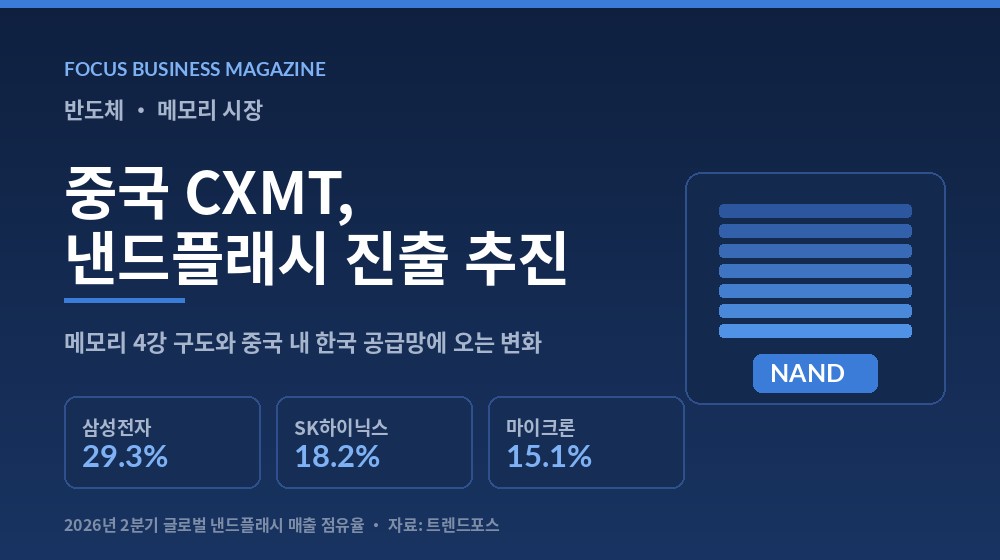
- Samsung Electronics 29.3% · SK hynix 18.2% · Micron 15.1%
- DRAM share
- Samsung 39.4% · SK hynix 24.9% · Micron 23.3% · CXMT 9.5% (4th worldwide)
- CXMT investment
- Plans a NAND R&D production line at a new Beijing plant; separate Beijing research institute
- Supply talks
- NAND chips for AI system and supercomputer storage products
- Main variable
- US export controls on advanced semiconductor equipment
- YMTC factor
- Possible entry into DRAM mass production in late 2026 after customer feedback
Behind on technology, but price is another matter
The NAND flash market is currently led by Samsung Electronics (29.3%), SK hynix (18.2%) and Micron (15.1%). The DRAM market CXMT has focused on is likewise led by Samsung (39.4%), SK hynix (24.9%) and Micron (23.3%), with CXMT fourth worldwide at 9.5%. All figures are on TrendForce’s Q2 2026 global revenue basis.
The industry view is that Chinese memory makers still trail Korean leaders on technology. In a market where memory chips are in short supply, however, the calculus changes: aggressive pricing opens room to take share. Reuters assessed that supply constraints are strengthening the bargaining position of CXMT and NAND specialist Yangtze Memory Technologies (YMTC), particularly in China’s domestic market.
Notably, the boundary-crossing runs both ways. CXMT, a DRAM maker, is moving into NAND; YMTC, a NAND maker, into DRAM. Analysts note that if YMTC enters DRAM mass production in late 2026 after customer feedback, direct competition with Korean fabs in low-cost LPDDR lines would be hard to avoid.
Three things Korean businesses in China should watch
First, the price floor on commodity memory. The source report notes that Samsung and SK hynix could see weaker pricing power in commodity memory. High-bandwidth memory and high-value server products are a different story. If your purchasing costs track memory prices — electronics and IT distribution, device assembly, server and storage supply — track commodity and high-value price trends separately.
Second, the pace of Chinese customers’ capital spending. The report points out that materials, components and equipment suppliers are exposed to swings depending on whether Chinese customers slow their investment. Korean suppliers serving Chinese memory makers should manage announced investment plans and actual execution as two separate things. CXMT’s line is still at the “planned R&D production line” stage, not confirmed mass production.
Third, US equipment controls will decide the direction. The opposite scenario deserves equal weight. If tight US equipment controls persist and the adoption of advanced lithography and etching processes is delayed, Chinese firms’ move into new segments may stall at the R&D stage, limiting share gains. When planning business in China, it is more practical to prepare two scenarios keyed to the regulatory variable than to treat a Chinese memory breakthrough as a settled fact.
In the end, the second-half global semiconductor supply picture depends on how quickly Chinese memory makers execute their capital spending and on the results of YMTC’s DRAM sample validation. Until those two are clear, there is no reason to rush a judgment.
Sources
- Source report
- Global Economic, “China’s relentless semiconductor expansion — will it shake Korea’s memory crown?” (19 Sep 2026, by Kim Ju-won)
- Primary source
- Reuters, 18 September 2026 (local time)
- Share data
- TrendForce, Q2 2026 global revenue tally
※ This article was auto-drafted from a Global Economic report dated 19 September 2026. Editorial review is required before publication.
← Back to list