US–China Summit: 3-Hour 22-Minute White House Meeting — Details Undisclosed, Next Meetings Set for November APEC & December G20
Chinese President Xi Jinping made a three-day state visit to the United States from 23 to 25 September (local time) and met President Trump at the White House. The Oval Office talks ran 3 hours 22 minutes, but no specifics on tariffs, rare earths or other substantive matters were disclosed. The two leaders agreed to meet twice more this year — at the APEC summit in Shenzhen, China in November, and the G20 summit in Miami in December. For Korean businesses in China, this means the key variables that could reshape Korea–China trade — semiconductors above all — remain unresolved.
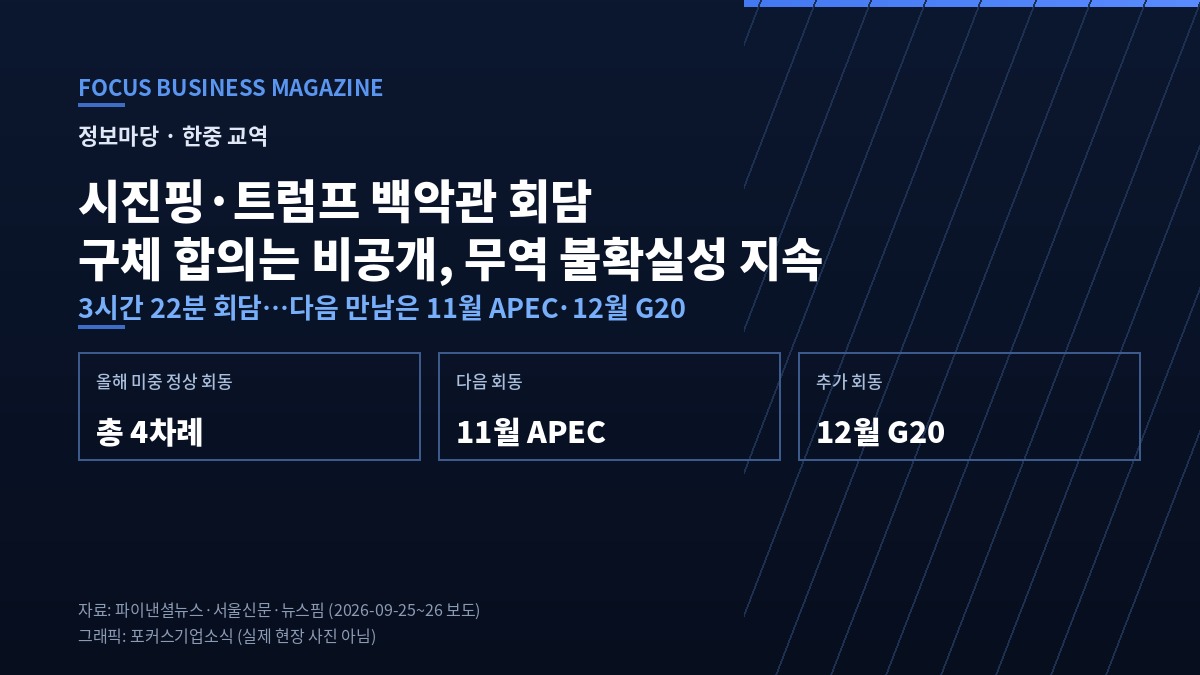
President Xi Jinping made a state visit to the United States from 23 to 25 September (local time) and met President Trump at the White House. According to the Seoul Shinmun (Washington correspondent Im Ju-hyung, 25 September), the talks in the Oval Office lasted 3 hours 22 minutes. Afterward, President Trump told reporters only that “we had a very good meeting,” and neither leader answered specific questions.
Financial News (reporter Park Ji-hyun, 26 September) reported that President Trump called it “enormous progress, a very positive and productive time for both countries,” suggesting positive outcomes for American farmers. That report likewise noted that no specific details of any agreement were disclosed.
Summit at a glance
- Visit dates
- 23–25 September 2026 (local time), three-day state visit
- Venue & duration
- White House Oval Office · 3 hours 22 minutes
- Next meeting
- APEC summit, November (Shenzhen, China)
- Following meeting
- G20 summit, December (Miami, US)
- Meetings this year
- May, Beijing (Trump's visit) · September, Washington (this meeting) · November & December planned — four in total
The one confirmed outcome: a two-month trade-truce extension
Newspim (25 September) assessed the summit as “dressed up on the outside but thin on substance.” According to that outlet, the clearest outcome was an agreement to extend the trade truce by two months; no substantive agreement was announced on tariff reductions or a new AI communication channel, both of which had been widely anticipated.
Newspim also noted that a pile of unresolved issues remains between the two countries: allegations of large-scale Chinese hacking of US election data, Chinese-made components found in weapons made by Yemen's Houthi rebels, China's continued imports of Iranian oil, and intensifying US–China competition in AI.
On Taiwan, the Seoul Shinmun reported that Xi asked Trump to “handle the Taiwan issue carefully,” but Trump's specific response was not disclosed.
A ‘fourth meeting’ running through November's APEC and December's G20
According to Financial News, Xi proposed two additional meetings this year and Trump accepted immediately — the APEC summit in Shenzhen in November and the G20 summit in Miami in December. Combined with Trump's visit to Beijing in May and this Washington meeting, the two leaders will have met four times this year.
Foreign media assessed that China leveraged its control of roughly 90% of the global rare-earth supply chain in the talks, while Trump negotiated from a relatively weaker position given domestic inflation pressure and the approaching midterm elections.
Three takeaways for Korean businesses in China
First, uncertainty over tariffs and rare earths remains unresolved. As this paper reported on 23 September, tariffs and a possible pause on rare-earth export controls had reportedly been on this summit's agenda, and the outcome was expected to shake the semiconductor-heavy structure of Korea–China trade. No such specifics were disclosed this time. Businesses exposed to tariff or export-control risk should plan for continued uncertainty rather than expecting a dramatic near-term shift.
Second, the next real signal is likely to come in November or December. With the two leaders set to meet again at APEC (Shenzhen) in November and the G20 (Miami) in December, any further progress on tariffs or export controls is more likely to emerge around those dates. Treat the interim period as low-risk for sudden policy shifts, but mark both summits on the calendar.
Third, the trade-truce extension is a safety valve, not a solution. The reported two-month extension eases the near-term risk of a sudden tariff shock, but does nothing to resolve the underlying frictions — hacking allegations, Iranian oil imports, AI competition. Korean businesses in China should keep planning around the possibility that these tensions persist, and continue reviewing supply-chain and customer diversification.
No official joint statement or detailed agreement had been published as of this writing. This paper will report further details as they become available.
Sources
- Report 1
- Financial News, “Trump: 'Enormous progress' for US–China…Xi proposes two more meetings this year” (26 September 2026, reporter Park Ji-hyun)
- Report 2
- Seoul Shinmun, “US–China summit ends…Xi spends 3 hours 22 minutes at the White House” (25 September 2026, Washington correspondent Im Ju-hyung)
- Report 3
- Newspim, “US–China summit dressed up on the outside, thin on substance” (25 September 2026)
- Related coverage
- Korea–China chip supply chains grow closer · Korea's exports to China jump 113.8% in the first 20 days of September
※ This article was auto-drafted from Financial News, Seoul Shinmun and Newspim reports dated 25–26 September 2026. Editorial review is required before publication.
← Back to list