34 years of Korea–China ties: ambassador says cooperation must move to ‘what we build together’
Speaking at a concert marking the 34th anniversary of Korea–China diplomatic relations, held at the ambassador's residence in Beijing on 24 August, Ambassador Roh Jae-heon said economic cooperation between the two countries must move past counting trade volume. Around 150 guests from government, business, academia and the arts attended, including four former ambassadors to China.
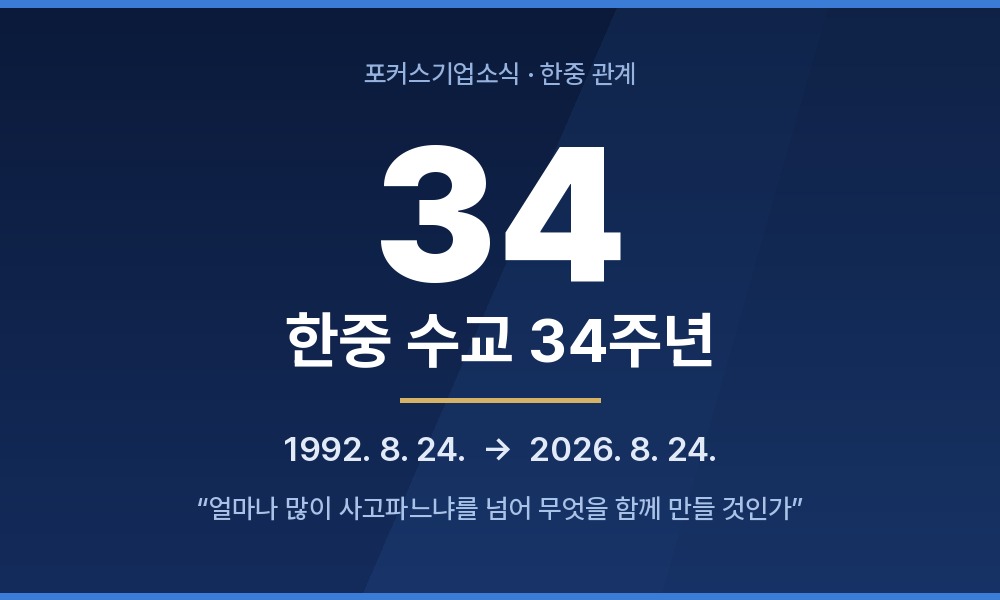
The Korean Embassy in China held an anniversary concert at the ambassador's residence in Beijing on 24 August under the theme "34 years of walking together, meeting through music." According to Asia Today, about 150 guests from both countries' governments, business circles, academia and the cultural sector attended, among them former ambassadors Shin Jung-seung (7th), Lee Kyu-hyung (9th), Noh Young-min (12th) and Jang Ha-sung (13th).
"Not how much we buy and sell, but what we create together"
In his welcoming remarks, Ambassador Roh recalled that "on 24 August 1992, after the long winter of the Cold War, Korea and China opened their doors to each other," adding that "what the leaders of the two countries foresaw at the time was surely more than an expansion of trade." It was, he said, "a belief that two long-standing neighbours could open their hearts and build peace and prosperity in East Asia together — and that choice was right."
Roh recalled how the two countries helped each other during the 1997 Asian financial crisis and the 2003 SARS outbreak, citing the Chinese expression shanshui xianglian, shouwang xiangzhu — neighbours joined by mountains and rivers look out for and help one another.
On the direction of economic cooperation he said: "The world is changing fast. Artificial intelligence and advanced technology are reshaping the industrial landscape. New challenges lie before us — supply chains, the green transition, climate change." He went on: "Korea–China economic cooperation must now move from 'how much do we buy and sell' to 'what will we create together.'"
On the Korean Peninsula, Roh said that "peace and stability on the peninsula is likewise a value the two countries must protect together," and that "Korea and China should continue to communicate closely and work together for peace and prosperity on the peninsula and in Northeast Asia."
Drawing on the setting, he added: "However fine the player, no one makes a symphony alone. It is only when we play together that a fuller resonance emerges" — and said he hoped the future of Korea–China relations would be the same.
Meeting reporters the same day, Roh said that "as neighbours, Korea and China may have their small disagreements," but "over the long run we have always cooperated. We are working through shared challenges together, and that will continue to unfold in our future."
Roh also paid tribute on social media to the late Chinese leader Deng Xiaoping, who helped bring about the normalisation of relations. Citing sources in Beijing, Asia Today reported that Chinese Ambassador to Korea Dai Bing is understood to have visited the grave of Roh's father, former President Roh Tae-woo, on the same day.
34th anniversary concert
- Date
- 24 August 2026
- Venue
- Korean ambassador's residence, Beijing
- Theme
- 34 years of walking together, meeting through music
- Attendance
- About 150 guests from government, business, academia and the arts
- Former ambassadors
- Shin Jung-seung (7th), Lee Kyu-hyung (9th), Noh Young-min (12th), Jang Ha-sung (13th)
[Analysis] Two things Korean businesses should note
An anniversary speech is not policy. But the language an ambassador chooses in public is a useful signal of where the embassy will direct its attention. Two points stood out to our editorial desk.
1. The centre of gravity is shifting from trade to joint development
"Beyond how much we buy and sell, to what we create together" reads as a shift of policy interest away from import–export intermediation and towards joint R&D, shared brands and local production partnerships. The pairing with AI and advanced technology, supply chains, the green transition and climate change points the same way.
Companies still operating purely in trade or distribution should allow for the possibility that bilateral cooperation programmes announced over the next year or two will carry "joint development" or "joint venture with a local partner" conditions. What is worth doing now is not an elaborate plan but a concrete shortlist of potential Chinese partners, named company by company. Starting the search after a call for applications opens is usually too late.
2. The real milestone is next year's 35th anniversary
Thirty-four is a symbolic number; what the two governments are actually preparing for is the 35th anniversary in 2027. At the Korea–China foreign ministers' meeting in Seoul on 19 August, the two ministers likewise discussed using next year's anniversary to lift bilateral ties to a higher level. Anniversary years falling on five-year intervals typically bring larger budgets and more events in cultural and economic exchange.
Overseas Korean organisations and Korean business associations would do well to work backwards from when 35th-anniversary programmes are likely to open for applications. The Overseas Koreans Agency's support programme for overseas Korean organisations generally runs its needs survey and application rounds on a half-yearly cycle, so having a project concept ready by late this year should allow a response to next year's first-half round. Exact schedules and eligibility must be checked directly via the overseas Koreans portal (korean.net) and the notices of the consulate general with jurisdiction.
Korea–China calendar, second half of 2026
- 8–11 October
- 30th World Korean Business Convention, Shenzhen, China
- 18–19 November
- APEC summit, Shenzhen — a Korea–China leaders' meeting is being pursued
- 31 December
- Current end date of China's visa-free entry policy for holders of ordinary Korean passports
- 24 August 2027
- 35th anniversary of Korea–China relations
※ Whether the visa-free policy is extended depends on announcements by the Chinese government. Please check notices from Korean missions in China or the Chinese visa application service centre before travelling.
In short
The temperature of Korea–China relations feeds directly into the operating environment for overseas Koreans and Korean businesses. That four former ambassadors sat together at the anniversary event is itself a picture of the current mood. But mood is not policy. Actual conditions for customs clearance, licensing and visas must be confirmed case by case with the relevant customs office, the KOTRA trade centre and the consulate general.
Focus Business Magazine will continue to track follow-up measures through November's APEC summit in Shenzhen and next year's 35th anniversary.
Sources
- Event and remarks
- Asia Today, "Ambassador Roh Jae-heon stresses moving Korea–China cooperation a step further" (25 Aug 2026)
- 34th anniversary
- Newsis, "Ambassador to China marks 34th anniversary: 'Korea–China cooperation must move a step forward'" (24 Aug 2026)
- Foreign ministers' meeting
- Focus Business Magazine, "Korea–China foreign ministers agree to cooperate on FTA services–investment talks and supply-chain stability" (21 Aug 2026)
※ This article is an automatically generated draft based on reporting by Asia Today (25 Aug 2026) and Newsis (24 Aug 2026). Editorial verification is required before publication.
← Back to list