Korea–China foreign ministers agree to cooperate on FTA services–investment talks and supply-chain stability
Korean Foreign Minister Cho Hyun and Chinese Foreign Minister Wang Yi met in Seoul on 19 August. The two agreed to cooperate on the Korea–China FTA services and investment negotiations, supply-chain stability and people-to-people and cultural exchange, and shared the view that a leaders' meeting should be pursued on the margins of November's APEC summit in Shenzhen.
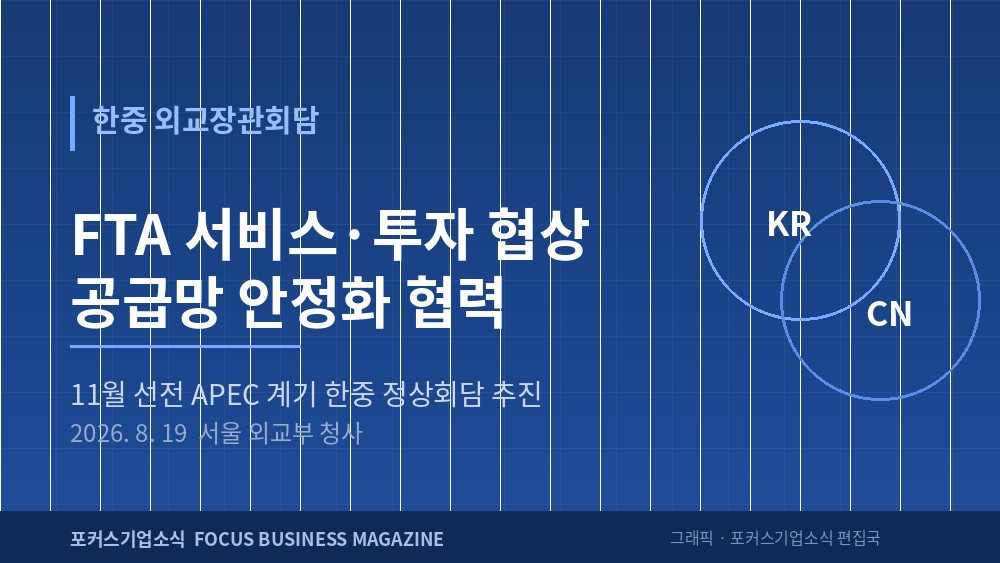
Wang Yi, member of the Political Bureau of the CPC Central Committee and Foreign Minister, made an official visit to Korea from 19 to 20 August. It was his first standalone visit to Korea in about five years, since September 2021, and the first Korea–China foreign ministers' meeting in 11 months, following talks in Beijing last September. The visit came five days before the 24 August anniversary of Korea–China diplomatic relations.
Areas of cooperation identified
At the meeting and dinner held on 19 August at the Ministry of Foreign Affairs building in Jongno-gu, Seoul, Cho and Wang discussed how to use next year's 35th anniversary of diplomatic relations to lift bilateral ties to a higher level. According to the ministry, the two agreed to cooperate in the following areas.
Areas of agreed cooperation (19 August 2026)
- Trade
- Korea–China FTA services and investment negotiations
- Industry
- Supply-chain stability
- Exchange
- Expanded people-to-people and cultural exchange
- Symbolic project
- Introduction of giant pandas
- History
- Management and preservation of Korean independence-movement sites in China
- Summit diplomacy
- Pursuit of a leaders' meeting on the margins of the November APEC summit in Shenzhen
Wang said China was actively considering a Korea–China leaders' meeting should President Lee Jae-myung attend the APEC summit in Shenzhen in November, and he invited Cho to visit China.
Differences also surfaced on sensitive issues. Cho conveyed the Korean government's principled position on the West Sea and raised the safety and protection of the rights of Korean nationals in China. On the Korean Peninsula, he explained the vision of peaceful coexistence set out in President Lee's Liberation Day address and asked China to play a constructive role in bringing North Korea back to dialogue. Wang replied that China would continue to play a constructive role for peace and stability on the peninsula.
Wang urges an early conclusion to the second-phase FTA talks
Wang called on President Lee Jae-myung at Cheong Wa Dae on 20 August. According to China's official Xinhua News Agency, Wang said that "China will become the world's largest market" and that it is "willing to share development opportunities with all countries, particularly its neighbours."
On economic cooperation, he said that "with fragmentation in the world economy deepening and trade protectionism on the rise, Korea and China should play an exemplary role," and urged an early conclusion to the second phase of the Korea–China FTA negotiations. He added that both sides should "promote regional economic integration through concrete measures and advance inclusive and mutually beneficial economic globalisation." It is unusual for Beijing to press publicly for an early wrap-up of the FTA follow-up talks at a meeting of this level.
Lee said that following his meetings with Chinese President Xi Jinping last year and this year, the two countries were "producing clear results in the full restoration of Korea–China relations," and that "the two governments are strengthening horizontal and mutually beneficial cooperation in the economic field on the basis of political trust." He added that Korea "will spare no support needed for the successful hosting of APEC in Shenzhen this year," and expressed hope to meet President Xi again in Shenzhen in November, following Gyeongju last November and Beijing in January.
Wang also held a separate strategic dialogue with National Security Adviser Wi Sung-rak the same day, stressing "strategic autonomy" and saying he hoped Korea would "not engage in bloc confrontation or taking sides." After his Korean schedule, he travels to Indonesia through 22 August for a 2+2 meeting of foreign and defence ministers.
[Analysis] What Korean businesses should prepare for
The meeting produced agreement on direction, not a concluded treaty, so nothing changes in practice today. But once a direction is set, follow-up measures tend to move along it — and whether a company has prepared will show six months from now. Three points stand out to our editorial desk.
1. The second-phase FTA talks — service firms are most exposed
When the Korea–China FTA took effect in 2015, it was concluded largely on goods; services and investment were covered only by a clause committing both sides to open follow-up talks within two years. Those talks began in March 2018 and remain unfinished eight years on, held up by recurring differences over the scope of market opening.
Korea–China FTA services and investment talks: timeline
- Dec 2015
- Korea–China FTA enters into force (goods-focused)
- Mar 2018
- Services and investment follow-up talks (phase two) begin
- 22–26 Jun 2026
- 15th round, Beijing — services, investment and finance
- 20 Aug 2026
- China publicly urges an early conclusion at a leaders-level meeting
- 18–19 Nov 2026
- Shenzhen APEC summit — the point at which results may be announced
A deal would matter less to goods importers and exporters than to firms running, or preparing to set up, service-sector entities on the ground — distribution, logistics and warehousing, management consulting, advertising and cultural content, education services, and finance-related lines of business.
One distinction is essential in practice: opening under the FTA and licensing under Chinese domestic law are two different things. Even where the FTA opens a sector, actual incorporation, equity ratios and operating licences must still clear the negative list for foreign investment access and the approval procedures of the relevant sectoral authority. Setting an entry timetable on the strength of an FTA headline alone tends to go wrong.
Two things are worth doing now. First, confirm the exact Chinese industrial classification code for your line of business — opening is decided code by code. Second, establish whether that code currently sits on the negative list and, if so, under what restriction (equity ceiling, joint-venture requirement and so on). With both settled, you can assess the impact on your own company within a day of any announcement.
2. Supply-chain stability — read it alongside the export controls due in November
The supply-chain language reads as boilerplate, but the timing matters. China's tightened export controls on rare earths and critical minerals are due to take effect in November 2026 and include extraterritorial application. For firms handling semiconductors, electronic components, auto parts or battery materials, whether this agreement turns into a working channel is a live variable.
Waiting on the agreement alone is risky. Before November, check by HS code whether your items fall under the licensing requirement, and if they do, build the expected licence processing time into your supply schedule.
3. People-to-people exchange — already visible in the numbers
Exchange is not new to this meeting; it extends a trend already under way. At aviation talks in Seoul on 27–28 May, the two sides agreed to add 70 weekly flights in traffic rights, raising Korea–China passenger services from 608 to 664 flights per week — the first increase in seven years.
Companies with frequent travel should watch for route announcements in the second half. More capacity on Tianjin, Qingdao and Shenyang routes, where Korean communities are concentrated, feeds straight into travel costs and logistics lead times.
The most direct point for Koreans in China
Cho separately raised the safety and protection of the rights of Korean nationals in China. No specific follow-up has been announced, but it means the government-to-government channel on consular and immigration matters is open. Where problems arise locally, documenting them with the competent consulate general builds the record that such consultations rest on.
In short
The Shenzhen APEC summit on 18–19 November is the pivot. Whether progress in the second-phase FTA talks is announced there, and whether a supply-chain consultation mechanism takes concrete form, will determine how much this agreement is worth. The three months until then are best spent confirming industry codes, screening items against the export-control list, and tracking route information. Customs clearance, licensing and other practical conditions should be verified case by case through the competent customs office, a KOTRA trade office, or a qualified customs broker or legal adviser.
Focus Business Magazine will continue tracking the Korea–China FTA follow-up talks and supply-chain measures through to the Shenzhen APEC summit in November.
Sources
- Meeting content
- Ministry of Foreign Affairs, Republic of Korea — readout of the Korea–China foreign ministers' meeting (19 Aug 2026)
- Wang Yi's remarks
- Xinhua News Agency — reporting on the Cheong Wa Dae call and strategic dialogue (20 Aug 2026)
- APEC schedule
- State Council of China: 2026 APEC Economic Leaders' Meeting to be held 18–19 November in Shenzhen
- FTA follow-up talks
- Ministry of Trade, Industry and Energy, Republic of Korea — 15th round of Korea–China FTA services and investment talks (June 2026)
- Air traffic rights
- Ministry of Land, Infrastructure and Transport, Republic of Korea — Korea–China aviation talks, 70 additional weekly flights (27–28 May 2026)
※ The account of the meeting reflects information available as of 21 August 2026. Negotiations and regulatory conditions may change; please verify with the competent authorities before acting on this information.
← Back to list