PBOC publishes yuan policy stance: "We do not engage in competitive devaluation"
The People's Bank of China (PBOC) published a policy stance on the renminbi exchange rate on Oct. 8, responding directly to Western claims that Beijing deliberately weakens its currency to boost exports. The central bank said the yuan has risen about 9% against the dollar since 2025 and stated flatly that China does not engage in competitive devaluation.
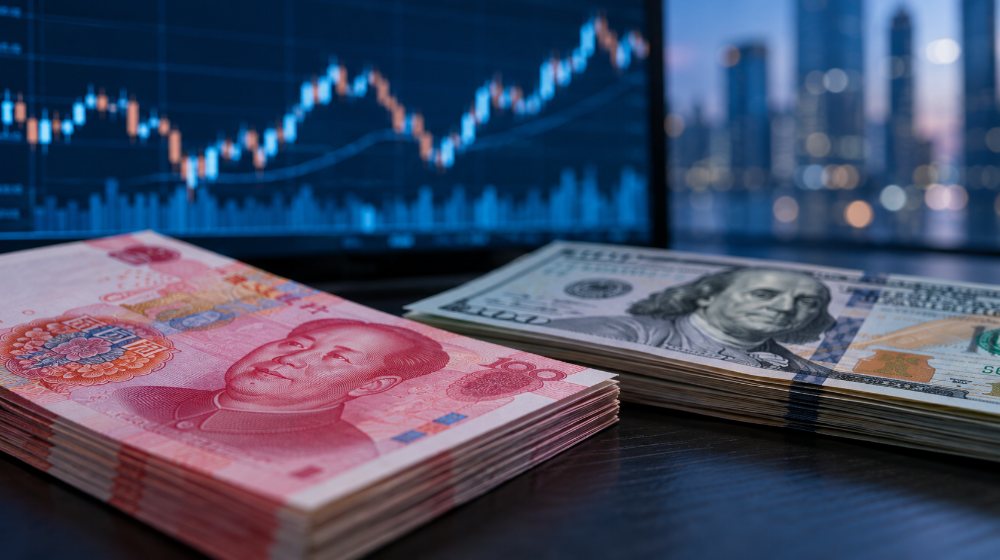
"The market sets the rate"
The PBOC described the current regime as a managed float based on market supply and demand, with reference to a basket of currencies. It said it sets no target level for the exchange rate and does not intervene in its long-term trend. It added that it exited regular foreign-exchange intervention after 2017.
It did leave room to act. During major external shocks such as the outbreak of COVID-19 and the tariff shock of April 2025, it used macroprudential tools, and in extreme scenarios it intervenes directly. The aim, it said, is to prevent sharp short-term swings, especially rapid depreciation.
The numbers behind the argument
Since 2010 the yuan has gone through three cycles each of appreciation and depreciation, trading between 6.04 and 7.35 per dollar. Since the 2005 exchange-rate reform, its nominal effective rate as measured by the Bank for International Settlements (BIS) has risen more than 50%, and its real effective rate 35%.
The PBOC stressed that the exchange rate and export share have not moved together. When the yuan rose 21% in 2005–2008, China's share of world exports rose 2.4 percentage points; when it fell 7% in 2016, the share actually dropped 0.7 points. High-tech trade grew 7.9% a year on average over the past five years and 11.4% in 2025, accounting for nearly 60% of overall trade growth. Export strength, it argued, comes from industry rather than the currency.
Market size was another argument. Global FX turnover averaged nearly $10 trillion a day in 2025, with yuan trading alone above $800 billion a day. About 80% of that takes place offshore, which the PBOC said makes it hard for a central bank to steer the medium- to long-term trend.
Rebuttal on IMF assessments
The PBOC said using results of the International Monetary Fund's External Balance Assessment (EBA) as evidence of yuan undervaluation distorts and misuses them. The EBA looks at the real effective exchange rate, so it cannot be applied directly to the nominal or dollar rate, and its methods produce widely differing results.
On global imbalances, it said both surplus and deficit countries share responsibility: deficit countries should consolidate their finances and raise savings, while surplus countries should boost consumption and investment. It also said China will report additional FX-related data to the IMF from 2027.
Key points of the statement
- Published
- Oct. 8, 2026 · People's Bank of China
- Yuan since 2025
- Up about 9% against the dollar
- Range since 2010
- 6.04–7.35 per dollar
- Yuan FX trading
- Over $800 billion a day, about 80% offshore
- Intervention
- No regular intervention; direct action in extreme cases
Business Checkpoints
The document explains a position; it does not change policy. The PBOC itself noted that forces pushing the yuan up and down both exist and that its direction is uncertain. Rather than planning around one direction, firms are better off preparing for both.
If the yuan keeps strengthening, subsidiaries that pay local costs with money sent from Korea will get fewer yuan for the same amount of won, while profits sent home from China will be worth more in won. Firms may want to align the currencies of their costs and revenues and review hedging terms with their banks in advance. Exchange rates could resurface in US–China trade talks, so Washington's response is also worth watching.
References
- Primary source
- People's Bank of China, policy stance on the RMB exchange rate (Oct. 8, 2026)
- Reporting
- Xinhua (Oct. 8, 2026)
- Korean media
- Newspim (Oct. 9, 2026)
※ This article is based on the People's Bank of China statement and Korean and international media reports.
← Back to list