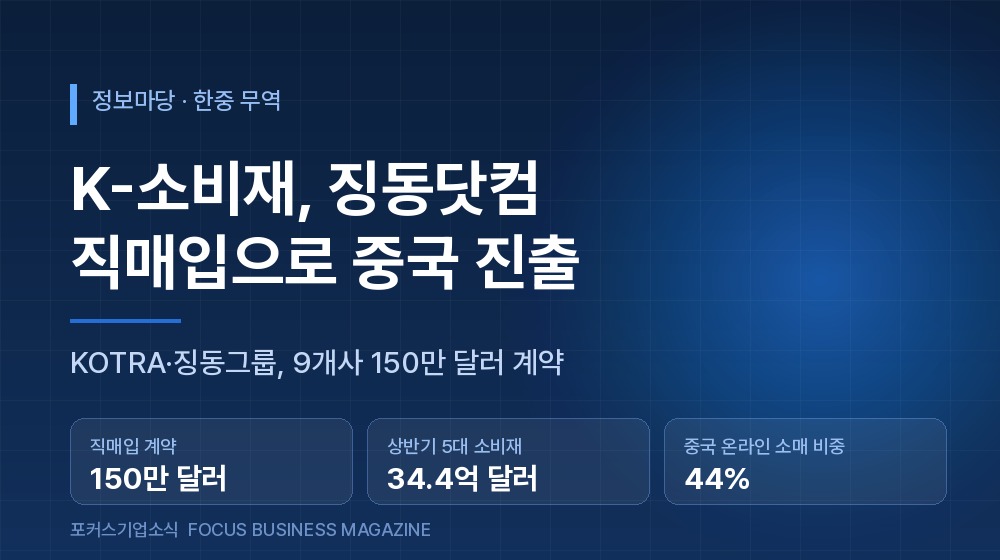
JD.com Expands Direct Purchasing of Korean Consumer Goods — US$1.5m in Deals with Nine Firms
KOTRA invited a buying delegation from JD Group, China's largest e-commerce company, to Seoul for a direct-purchase onboarding session. Nine Korean consumer-goods firms signed import contracts worth US$1.5 million for delivery this year. JD set up a dedicated sourcing entity in Korea in June, signalling a shift to routine procurement.
For Korean firms trying to place products in the Chinese consumer market, the biggest hurdle has always been the question of who does the selling. Going through a local Chinese vendor gets you in quickly but leaves you carrying margin pressure and inventory risk; and even after listing on a platform, a product without anyone pushing volume behind it is soon squeezed off the shelf. That structure may now be changing.
The Korea Trade-Investment Promotion Agency (KOTRA, CEO Kang Kyung-sung) said on 12 August that it had hosted a JD Group buying delegation at its Seoul headquarters for a “JD.com direct-purchase onboarding briefing and matchmaking session.” The key word is direct purchase: the platform buys Korean products outright and sells them as its own inventory — a very different allocation of risk from the traditional vendor route.
JD set up a Korean sourcing entity in June
To expand its buying of Korean consumer goods, JD Group established a dedicated sourcing entity in Korea on 18 June. A Chinese platform placing a purchasing organisation on the ground in Korea suggests this is not a one-off promotion but an attempt to build a standing procurement channel. KOTRA says it will strengthen support for this direct-purchase model — in which large online retailers such as JD buy Korean products themselves — alongside the existing route through Chinese vendors.
Some 200 Korean consumer-goods companies attended the session. Of these, 54 firms shortlisted jointly by JD and KOTRA held 54 one-to-one buying consultations with category merchandisers. On the day, JD signed import contracts worth US$1.5 million for delivery this year with nine companies. Products from the fashion brand 리끌로우 (Ricclow) were brought in under the direct-purchase model, and a self-operated flagship store was opened on JD.com.
Key figures
- Event
- JD.com direct-purchase onboarding briefing & matchmaking (12 August 2026, KOTRA Seoul HQ)
- Attending firms
- About 200 Korean consumer-goods companies
- One-to-one consultations
- 54 shortlisted firms · 54 meetings
- Contracts signed
- US$1.5 million with nine firms, for delivery within the year
- JD's Korean sourcing entity
- Established 18 June 2026
- H1 exports, five consumer categories
- US$3.44bn (vs US$3.16bn a year earlier, +8.7%)
- Online share of Chinese retail
- 30% in 2020 → over 44% in H1 2026
Consumer-goods exports are already recovering
The backdrop is a slow but steady recovery in consumer-goods exports. In the first half of this year, exports to China across five categories — cosmetics, food, fashion apparel, household goods and pharmaceuticals — came to US$3.44 billion, up 8.7% from US$3.16 billion a year earlier. This is a different animal from the explosive chip-led trade growth of recent months. These categories rest on real demand rather than price cycles: swings are smaller, but once a sales channel is secured, repeat orders follow more readily.
The centre of gravity in distribution is also shifting fast. Online's share of Chinese retail in goods and services has widened from 30% in 2020 to more than 44% in the first half of this year. The money and time once spent securing offline shelf space now has to be recalculated as visibility and logistics within a platform.
“To enter the Chinese market effectively as it evolves through digitalisation, urbanisation and ageing, cooperation with major local platforms is essential,” KOTRA's Kang Kyung-sung said, adding that the agency would do its utmost to help Korean consumer-goods firms reach overseas markets through partnerships with large distribution networks in each country. JD plans to expand its Korean consumer-goods section on JD.com and to keep identifying promising suppliers together with KOTRA.
What it means for Korean businesses in Tianjin and northern China
The event took place in Seoul, but it carries several practical implications for Korean-run trading and distribution businesses on the ground in China.
First, the role of the middleman is changing. As platform direct purchasing grows, the space for purely intermediary vendors narrows. Conversely, demand may rise for those handling what platforms cannot easily do themselves — customs clearance, certification, warehousing, after-sales service, local marketing. Now is the moment to ask whether what you do is “passing goods along” or “something only a local operator can do.”
Second, it is an opening to connect with head offices in Korea. JD's Korean sourcing entity means supply-side information from Korea will now be gathered continuously. A Korean firm in China that understands real demand and competition in a given category has room to create business by feeding that intelligence to Korean manufacturers.
Third, prepare the paperwork in advance. Cosmetics, food and pharmaceuticals face demanding category registration, filing (备案) and labelling rules on entry to China, and these steps often take longer than the contract itself. A direct-purchase deal is of little use if certification is not ready and the season is missed.
KOTRA operates 20 trade offices across China, including Tianjin, through which companies can check onboarding and matchmaking opportunities. Schedules and eligibility for future sessions vary by announcement, so interested firms should check the notices on KOTRA's Trade Investment 24 portal (www.kotra.or.kr) directly.
Sources
- Original report
- Newspim, “KOTRA expands K-consumer goods exports with China's JD… US$1.5m in contracts this year” (12 Aug 2026, by Kim Ha-young)
- Issuing bodies
- Korea Trade-Investment Promotion Agency (KOTRA) · Ministry of Trade and Industry
- Notices
- KOTRA Trade Investment 24
※ This article was auto-drafted from a Newspim report dated 12 August 2026. Editorial review is required before publication.
← Back to list