JD Expands Direct Purchasing of Korean Consumer Goods, Signs US$1.5m with Nine Firms in Seoul
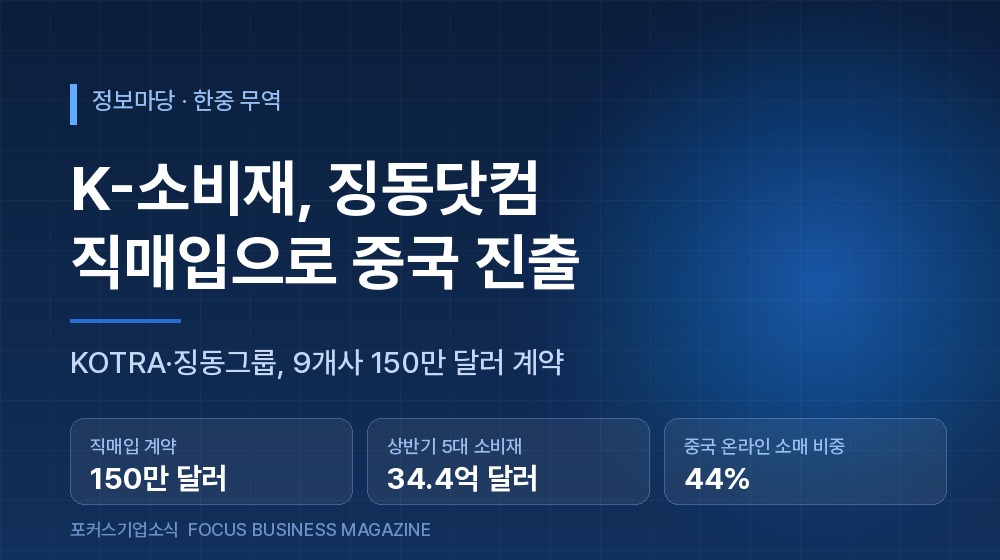
China's JD Group is buying more Korean consumer goods directly. At an onboarding session held in Seoul on 12 August by Korea's Ministry of Trade, Industry and Resources and KOTRA, nine Korean companies signed contracts with JD worth about US$1.5 million. It widens a route for Korean firms to supply a major platform directly, without going through intermediary distributors in China.
The “JD.com direct-purchase onboarding briefing and consultation session” took place at KOTRA's headquarters in Yangjae-dong, Seoul. Some 200 Korean consumer-goods companies attended the briefing. Of these, 54 firms chosen jointly by JD and KOTRA held one-on-one meetings with JD's category buyers.
How direct purchasing differs
Under direct purchasing, the platform buys products outright and sells them from its own inventory. Unlike the usual route through a distributor in China, Korean firms carry less of the local logistics and payment burden. One of the signing companies, fashion brand Reclow, entered JD on a direct-purchase basis and also opened a flagship store on JD.com.
JD's sourcing entity in Korea
JD set up a dedicated sourcing entity in Korea on 18 June and is expanding imports of Korean products. A JD Group vice chairman said demand for K-beauty and food would grow as the Korean Wave spreads, and that JD would keep increasing direct purchases of Korean goods. JD plans to enlarge its Korean consumer-goods section on JD.com and to scout promising suppliers together with KOTRA.
A modest recovery in consumer exports
Ministry figures show Korea's consumer-goods exports to China peaked at about US$9.3 billion in 2021 and fell steadily to US$6.46 billion in 2025. In the first half of this year they rebounded to US$3.44 billion, up 8.7% from a year earlier. The government said two recent Korea–China summits had created favourable conditions for Korean consumer goods in China's domestic market.
The session at a glance
- Event
- 12 August 2026 · KOTRA headquarters, Seoul
- Attendance · Meetings
- About 200 firms · 54 one-on-one meetings
- Contracts
- Nine firms · about US$1.5 million
- JD Korea entity
- Established 18 June 2026
- H1 consumer-goods exports to China
- US$3.44 billion (+8.7%)
Business Checkpoints
As platforms buy directly, distributors that only broker deals may see their share shrink. Work that can only be done on the ground, such as customs clearance, cosmetics and food registration, warehousing and after-sales service, is likely to stay in demand. Korean traders and distributors in China may want to ask which side their business is closer to.
Cosmetics and food must complete registration or filing and meet labelling rules before sale in China, and this often takes longer than signing a contract. Firms hoping for direct-purchase deals should get their paperwork ready first. Dates for follow-up sessions are posted in KOTRA announcements.
References
- Primary source
- Ministry of Trade, Industry and Resources / KOTRA press release on the JD.com direct-purchase session (12 Aug 2026, Korean)
- Korean media
- CosinKorea · CNC News (12 Aug 2026)
※ This article is based on releases from Korea's Ministry of Trade, Industry and Resources and KOTRA, and on Korean media reports.
← Back to list