Korea–China FTA services & investment talks resume in Beijing on Aug 31
Korea's Ministry of Trade, Industry and Energy announced that the 16th round of Korea–China FTA follow-up negotiations on services and investment will take place in Beijing from August 31 to September 4. With both leaders having agreed to seek meaningful progress within the year, this round aims to accelerate market-opening talks in services, investment and finance.
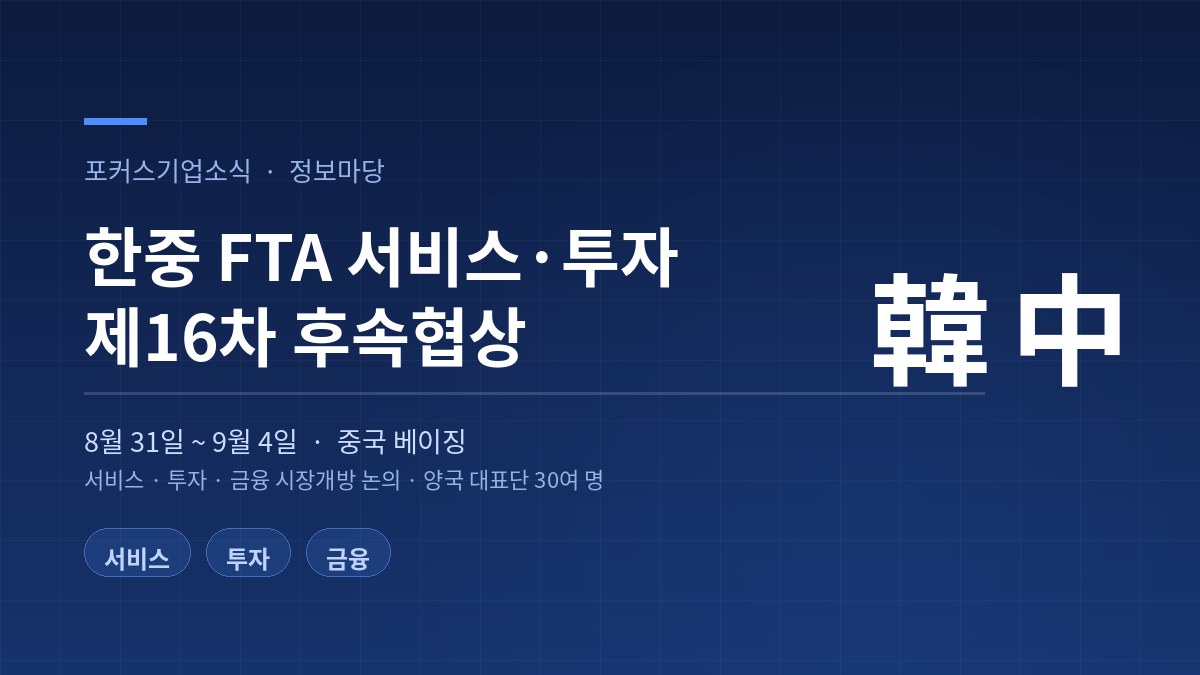
Korea and China are returning to the negotiating table over further opening of their services and investment markets. Korea's Ministry of Trade, Industry and Energy said on August 31 that the 16th round of Korea–China FTA follow-up negotiations on services and investment will be held in Beijing from August 31 through September 4.
About 30 delegates per side; Kwon Hye-jin and Chen Chao lead
Kwon Hye-jin, Deputy Minister for Trade Negotiations at Korea's Ministry of Trade, Industry and Energy, and Chen Chao, Director-General of the Department of International Trade and Economic Affairs at China's Ministry of Commerce, serve as chief negotiators, with roughly 30 delegates from each country taking part. The previous 15th round was held in Beijing on June 22 this year, when Lin Feng of China's Ministry of Commerce led the Chinese side.
16th round, Korea–China FTA services & investment negotiations
- Dates
- August 31 – September 4, 2026
- Venue
- Beijing, China
- Chief negotiators
- Korea: Kwon Hye-jin (MOTIE) / China: Chen Chao (MOFCOM)
- Scale
- About 30 delegates from each side
- Agenda
- Market opening in services, investment and finance
- Track record
- 15 formal rounds since talks began in March 2018
Eight years of talks since 2018
When the Korea–China FTA took effect in December 2015, the two countries separately agreed to hold follow-up negotiations to raise the level of liberalisation in services and investment. Those talks began in March 2018 and 15 formal rounds have been held to date.
The follow-up talks have two goals: to widen the range of service sectors each side opens to the other, and to make market-entry conditions clearer and more predictable. The intent is to extend a bilateral trade relationship long centred on goods into services as well.
Momentum has picked up this year
According to the ministry, the pace has quickened noticeably this year. In January, the leaders of Korea and China agreed to work toward meaningful progress in the services and investment talks within the year. Since then, the two sides have discussed ways to advance the negotiations through a Korea–China commerce ministers' meeting in March and talks in June between Korea's Trade Minister and China's International Trade Representative.
"Amid continued uncertainty in the trade environment at home and abroad, concluding the Korea–China FTA follow-up negotiations on services and investment could expand bilateral services trade and investment," Kwon said, adding that Korea would "do its utmost to produce a stable outcome that genuinely helps our companies."
What it means for Korean businesses in China
For Korean-run businesses in Tianjin and elsewhere in China, the significance of this round lies not in goods but in operating conditions. The current Korea–China FTA is built around tariff reduction on goods, so the regulatory environment facing service-sector operators on the ground has changed little.
The services, investment and finance areas under negotiation map directly onto the sectors local Korean businesses actually work in: distribution, logistics, travel and tourism, cultural content, professional services such as law, accounting and consulting, plus education and healthcare. If the list of open sectors widens, or if equity caps and licensing procedures become clearer, the range of viable entity structures and business scopes could change.
That said, eight years of talks also signal how far apart the two sides remain. This 16th round is an ongoing negotiating session, not a conclusion, and no details have been released on which sectors might open or how. Rather than firming up business plans on this basis now, it is safer to wait for the negotiation outcome and any subsequent regulatory notices.
Sector-level restrictions on foreign investment are governed by Chinese domestic rules such as the Negative List for Foreign Investment Access and the Catalogue of Encouraged Industries for Foreign Investment, so specific cases should be checked with the competent commerce authorities, a KOTRA trade office, or local legal and accounting advisers.
References
- Source report
- Asia Economic Daily, "Korea and China resume FTA services and investment follow-up talks" (2026-08-31)
- Announcing body
- Korea's Ministry of Trade, Industry and Energy (announced 2026-08-31)
- Previous round
- 15th round, Korea–China FTA services & investment negotiations, June 22, 2026, Beijing
※ This article was auto-drafted based on reporting by Asia Economic Daily (2026-08-31). Editorial verification is required before publication.
← Back to list