China's new exit-entry rules take effect September 15 — inviters liable for accuracy, false statements bring up to 5-year entry ban
The State Council Provisions on Exit and Entry Administration (State Council Decree No. 841) take effect on September 15. The 19-article regulation requires that applications for entry, exit, stay and residence be truthful and lawful; makes individuals and organizations that issue invitation letters responsible for their accuracy; allows a 1–5 year entry ban for foreigners who submit false documents or make false statements; introduces registration for exit-entry intermediaries; and permits exit restrictions on Chinese nationals who may harm industrial or technological security. Korean companies in China that invite staff, family members or business partners should review their invitation procedures before the rules kick in.
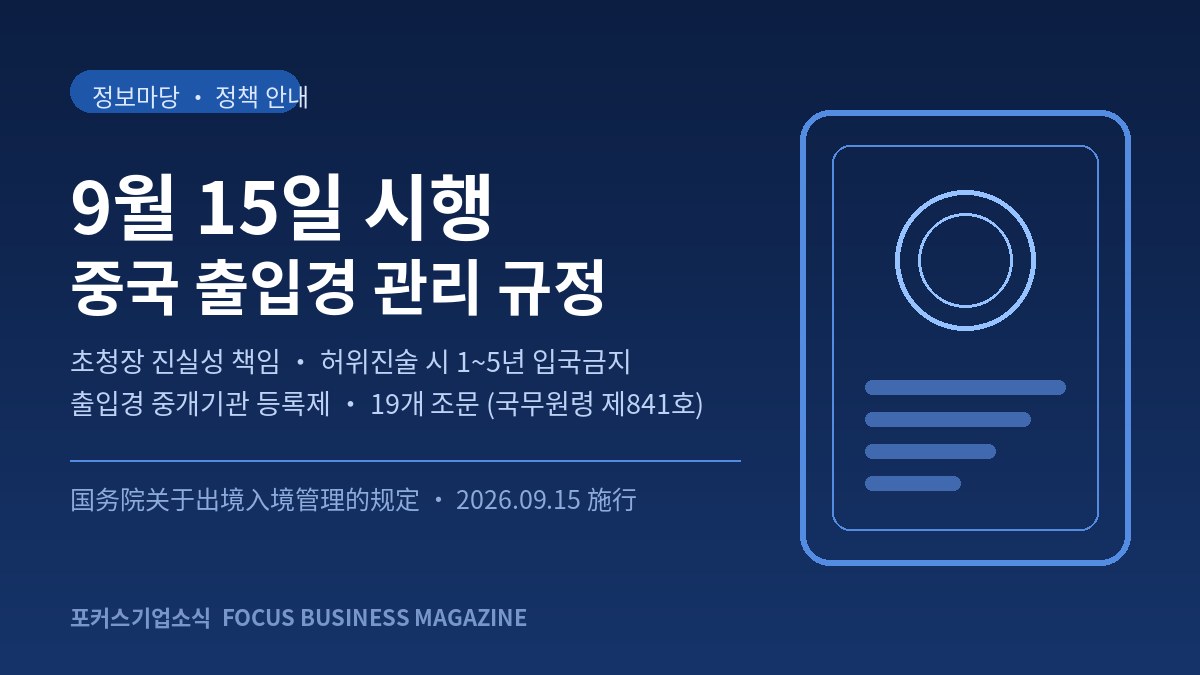
The State Council promulgated the Provisions on Exit and Entry Administration as Decree No. 841 on July 31. According to Xinhua, the regulation aims to standardize exit-entry administration, protect the lawful rights of travelers and safeguard national sovereignty, security and development interests, and it enters into force on September 15, 2026. It is implementing legislation under the Exit and Entry Administration Law (in force since 2013), fleshing out provisions the law only stated in principle.
Four pillars: safety warnings, application rules, restrictions, intermediaries
The regulation is built on four parts. First, an overseas safety-risk prevention system: the foreign affairs and culture-tourism departments of the State Council and diplomatic missions abroad must promptly publish overseas safety reminders and destination risk warnings based on war, armed conflict, public security conditions, natural disasters and epidemics. Second, application requirements: the grounds for applying for exit, entry, stay or residence must be truthful and lawful, and individuals and organizations that draft or issue invitation letters and other application materials are responsible for their accuracy.
Third, restriction measures: the regulation specifies the circumstances in which Chinese citizens may be barred from leaving and foreigners may be barred from entering. Fourth, intermediary services: organizations and individuals providing exit-entry intermediary services are subject to registration. According to an explainer by the National Immigration Administration, intermediaries must register with the local immigration authority within 15 days of establishment.
Provisions on Exit and Entry Administration — key points (State Council Decree No. 841)
- Promulgated · Effective
- Promulgated July 31, 2026 · Effective September 15, 2026 (19 articles)
- Invitation letters
- Individuals and organizations issuing invitation letters or other application materials are legally responsible for their accuracy
- False documents
- Submitting false materials or making false statements when applying for a visa or entry can result in refusal of visas and exit-entry documents and a 1–5 year entry ban
- Intermediary registration
- Exit-entry intermediary organizations and personnel must register (within 15 days of establishment)
- Exit restrictions on Chinese nationals
- Where violations of export-control or technology import-export rules may harm national industrial or technological security, the relevant authorities may restrict exit (Korean media report a re-exit ban of up to 3 years after return)
- Safety warnings
- Foreign affairs and culture-tourism departments and missions abroad to publish overseas safety reminders and destination risk warnings
The clauses that reach foreigners directly: invitation letters and false statements
The provisions with the most direct impact on Koreans and Korean companies in China concern invitation letters and false statements. Invitation letters have often been treated as a formality; from now on the company or individual issuing one is legally responsible for the accuracy of the stated purpose, duration and relationship. If a foreigner submits false documents or misstates facts when applying for a visa or entry, the immigration authority or visa office may refuse issuance and impose an entry ban of one to five years.
Korean media (Newsis, Financial News, August 1–3) focused on the exit-restriction clause for Chinese nationals. Where a person has violated export-control or technology import-export rules in a way that may harm national industrial or technological security, the relevant authorities may restrict exit, and the person may be barred from leaving again for up to three years after returning. Because this applies to Chinese nationals, it covers ethnic Korean-Chinese (Joseonjok) who retain Chinese citizenship as well as Chinese employees of Korean firms.
What Korean businesses in China should check
First, tighten invitation-letter procedures. Entities that issue invitations for head-office business trips, family visits or partner visits should keep a register and ensure the stated purpose, dates, address and cost-bearing party match reality. Letters habitually issued in an individual manager's name are better managed at the corporate level.
Second, visa-free entrants are not exempt. Holders of ordinary Korean passports can enter visa-free for up to 30 days for business, tourism or family visits through December 31, 2026, but misstating the purpose of the visit at immigration can trigger the same sanctions. Entering visa-free and then working or staying long-term is particularly risky.
Third, if you use a visa agent or intermediary, confirm it is registered. After the rules take effect, paperwork handled by an unregistered intermediary may leave the applicant exposed if problems arise. Fourth, if key Chinese technical staff are scheduled for overseas trips or training, check compliance with export-control and technology import-export rules in advance.
The full text and article-by-article commentary are available on the Chinese government portal (gov.cn) and the National Immigration Administration (nia.gov.cn); individual cases should be discussed with a local legal professional. Enforcement details may vary by local immigration authority once the rules are in force.
References
- Original text
- Chinese government portal — Provisions on Exit and Entry Administration (State Council Decree No. 841, promulgated 2026-07-31)
- Reports
- Xinhua, "State Council Provisions on Exit and Entry Administration to take effect Sept. 15" (2026-07-31) · Newsis, "China to bar exit of persons threatening industrial and technological security… revised exit-entry rules effective Sept. 15" (2026-08-03) · Dongpo World News, "Seven things Korean-Chinese should know about China's exit-entry rules effective Sept. 15"
- Commentary
- National Immigration Administration expert explainer
- See also
- China's data risk assessment rules take effect August 20
※ This article was auto-drafted based on the State Council decree and reporting by Xinhua (2026-07-31), Newsis (2026-08-03) and Dongpo World News. Editorial verification is required before publication.
← Back to list