China’s August Retail Sales Rise Just 0.4% — Factories Run, Domestic Demand Stalls
The August figures released by China’s National Bureau of Statistics on 15 September come down to one line: production beat expectations, while consumption and investment stayed weak. Retail sales grew only 0.4% year on year, while fixed-asset investment for January to August fell 7.2% — the steepest decline since April 2020. For Korean companies operating in China, how the economy feels right now depends heavily on which sector you are in.
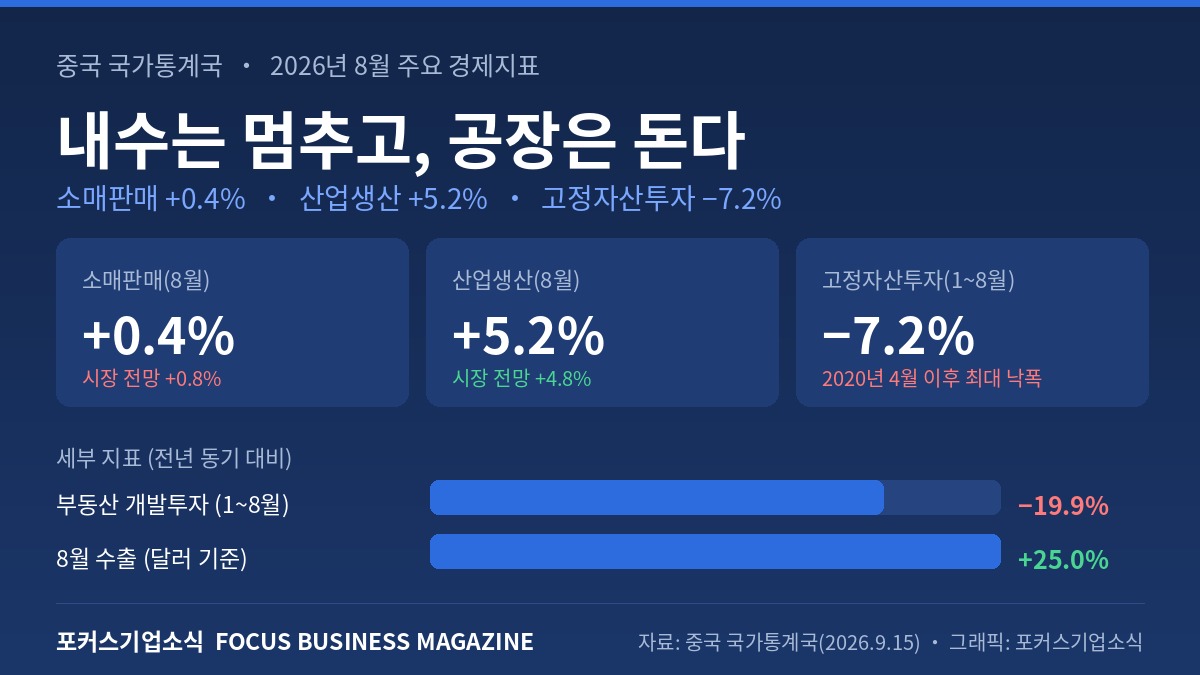
According to the National Bureau of Statistics release of 15 September, retail sales in August rose 0.4% from a year earlier. That is slower than July’s 0.6% and below the 0.8% consensus compiled by Reuters.
Industrial output, by contrast, rose 5.2%, beating both July’s 4.5% and the 4.8% market forecast. Equipment manufacturing grew 12.1% and high-tech manufacturing 16.7%, both double digits. Output of lithium-ion batteries rose 57.2%, industrial robots 34.6%, and 3D printing equipment 29.9%.
Exports appear to be bridging the gap between what China produces and what it consumes. The General Administration of Customs had earlier reported August exports up 25.0% year on year in dollar terms — in other words, volume that cannot be absorbed at home appears to be going abroad.
Key figures (August 2026, year on year)
- Retail sales
- +0.4% (July +0.6%; forecast +0.8%)
- Industrial output
- +5.2% (July +4.5%; forecast +4.8%)
- Equipment mfg / High-tech mfg
- +12.1% / +16.7%
- Li-ion batteries / Industrial robots / 3D printers
- +57.2% / +34.6% / +29.9%
- Fixed-asset investment (Jan–Aug cumulative)
- −7.2% (Jan–Jul −6.7%) · steepest since April 2020
- Property development investment (Jan–Aug)
- −19.9% (−4.2% excluding property)
- Exports (August, USD basis)
- +25.0%
- Urban surveyed unemployment (August)
- 5.3% (July 5.2%)
Most of the investment decline is property
Fixed-asset investment fell 7.2% year on year over January to August, a wider decline than the 6.7% recorded through July and the sharpest since April 2020. The composition, however, is fairly clear: property development investment fell 19.9% over the same period, and excluding property, the decline narrows to 4.2%.
The urban surveyed unemployment rate was 5.3% in August, up slightly from 5.2% in July.
The statistics bureau described August conditions as “generally stable” while acknowledging that the impact of an unfavorable external environment had deepened and that a structural contradiction of strong supply and weak demand had become pronounced domestically. It also noted that some firms are “experiencing operational difficulties.” The bureau’s own use of the phrase “strong supply, weak demand” is worth noting.
Zhang Yuhan, senior economist at the Conference Board China Center, told the South China Morning Post that the August data suggest China is relying increasingly on technology upgrades, productivity gains and overseas demand to absorb expanding industrial capacity, while domestic consumption and investment remain weak.
Three signals for Korean businesses in China
First, how this economy feels now splits sharply by sector. Within the same city, retail, food service, consumer-goods distribution and other businesses that depend on Chinese domestic demand are in a very different position from suppliers of parts and materials into manufacturing supply chains. The 0.4% figure is a nominal growth rate; factor in discounting and price competition and the reality at store level may be worse. Domestic-demand businesses would do well to revise remaining 2026 sales plans conservatively.
Second, 25% export growth is both an opportunity and a warning. Chinese manufacturers appear to be redirecting volume they cannot sell at home into overseas markets. If a Korean company supplies components, materials or equipment inside China, orders are likely to hold up for now. If its products compete with Chinese goods in Korea or third markets, expect heavier price pressure over the next several quarters — and watch trade-remedy activity (anti-dumping, safeguards) in destination markets.
Third, the property squeeze arrives as collection risk. A 19.9% fall in property development investment tightens cash flow across construction, interiors, building materials and equipment, their subcontractors, and local-government-funded projects. If payment terms in your China transactions are stretching out or settlement is shifting toward notes and bills, this is a moment to tighten collection terms rather than chase revenue.
These are single-month figures for August (fixed-asset investment is cumulative for January to August). The trend may shift depending on the strength of stimulus, fourth-quarter consumption measures and the external trade environment. The statistics bureau called for stronger macro-policy coordination and efforts to expand domestic demand, alongside industrial upgrading for “innovation-driven” growth. September data and fourth-quarter policy announcements are worth watching together.
Sources
- Original report
- Kyunghyang Shinmun, ‘China’s August consumption up 0.4%… imbalance between output, consumption and investment persists’ (15 Sept 2026, Beijing correspondent Park Eun-ha)
- Issuing bodies
- China National Bureau of Statistics · General Administration of Customs
- Primary data
- China National Bureau of Statistics
※ This article was auto-drafted from a Kyunghyang Shinmun report dated 15 September 2026. Editorial review is required before publication.
← Back to list