China's import rules for food, cosmetics and medical devices are “easing and tightening at once” — Tianjin seminar urges Korean firms to act early
China's rules on imported consumer goods are changing fast: procedures are getting simpler while the scope of regulation grows wider. At the 2026 Korean Business Support Seminar in Tianjin on 3 September, Park Jung-woo, head of the China branch of the Korea Testing & Research Institute (KTR), said the question is not whether rules are loosening or tightening, but reading the direction of change and preparing ahead. Here is what has changed in food, cosmetics and medical devices.
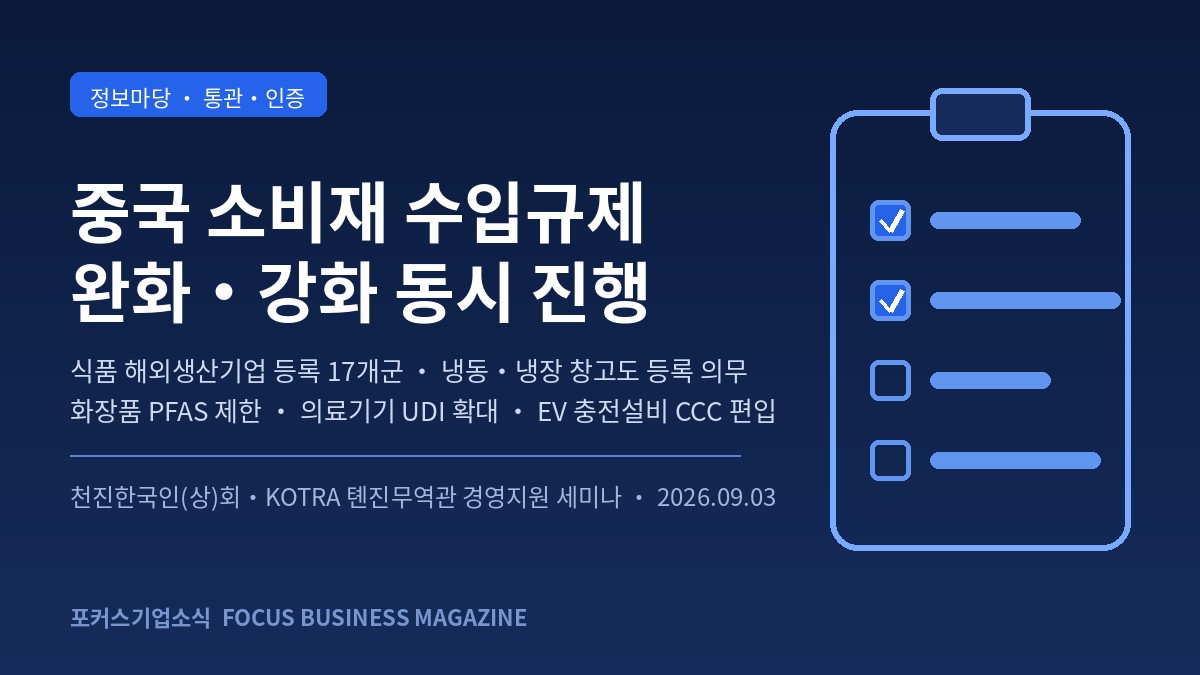
The seminar, co-hosted by the Korean Association of Tianjin (chair Shin Eun-sik) and KOTRA's Tianjin Trade Center (director Kang Min-ju), took place on 3 September at the association's cultural hall in Tianjin. Representatives of Korean companies operating in Tianjin attended to hear about regulatory changes and emerging-industry trends in the Chinese market.
In the first lecture, on trends in China's import regulations for food, cosmetics and medical devices and how to respond, Park said that “recent Chinese consumer-goods regulation is easing and tightening at the same time, sector by sector,” and that companies should look past whether a given rule is relaxed and instead read where the changes are heading.
Seminar at a glance
- Event
- 2026 Korean Business Support Seminar
- Date & venue
- 3 September 2026 (local time) · Korean Association of Tianjin cultural hall, Tianjin
- Hosts
- Korean Association of Tianjin (chair Shin Eun-sik) · KOTRA Tianjin Trade Center (director Kang Min-ju)
- Lecture 1
- Park Jung-woo, head of KTR China branch — Trends in China's food, cosmetics and medical-device import rules and how to respond
- Lecture 2
- Lee Beol-chan, Chosun Ilbo China correspondent — Growth and business opportunities in China's humanoid robot industry
Food — registration is easier, but warehouses are now covered
For food, the registration system for overseas producers has been overhauled. The number of managed food categories was adjusted from 18 to 17, applications are now unified as self-registration by the company, and renewal procedures for some items were simplified. That is the easing side.
On the other side, the scope of regulation has extended from production plants to distribution and storage. Overseas storage facilities such as frozen and chilled warehouses now carry a registration obligation. For a company shipping chilled or frozen food from Korea to China, that means checking the registration requirements not just for the factory but for every cold-chain storage facility the product passes through.
Park singled out Chinese-language labels as a recurring problem at customs. There are cases where the product itself is fine but clearance stalls because the labelling does not meet Chinese requirements, so labels should be checked before export.
Cosmetics — less paperwork, stricter ingredient rules
Cosmetics follow a similar pattern. Procedures are being simplified, with a lighter burden for some products to submit proof of sale in the country of origin and toxicology test reports. At the same time, restrictions on certain ingredients such as PFAS (per- and polyfluoroalkyl substances) and stronger safety standards are on the way. Where a formulation has to change, development and re-registration take time, so this is something to prepare for now.
Medical devices and industrial goods — wider UDI, wider CCC
Institutional change continues for medical devices and industrial products: expanded application of the unique device identifier (UDI), a revised classification for in-vitro diagnostic reagents, and a shift to third-party compulsory certification. The scope of certification is also growing, with electric-vehicle charging equipment now brought under China Compulsory Certification (CCC).
“Whether or not a product is subject to compulsory certification, anything distributed in China must meet the national standards (GB),” Park said. “Building China's regulatory and certification requirements in from the product-development stage is the way to save cost and time.”
Changes by sector
- Food (easing)
- Managed categories for overseas producer registration 18 → 17 · unified as company self-registration · simpler renewal for some items
- Food (tightening)
- Scope extended from production plants to distribution and storage · new registration duty for overseas storage facilities such as frozen/chilled warehouses
- Food (watch)
- Repeated clearance delays over non-compliant Chinese labels — check labelling before export
- Cosmetics (easing)
- Lighter burden for some products to submit country-of-origin sale certificates and toxicology reports
- Cosmetics (tightening)
- Restrictions on certain ingredients such as PFAS · stronger safety standards planned
- Medical devices & industrial goods
- Wider UDI · revised IVD reagent classification · shift to third-party compulsory certification · EV charging equipment added to CCC
- Across the board
- Products sold in China must meet national standards (GB) regardless of certification status
Humanoid robots — “where EVs were in 2015–2016”
In the second lecture, Chosun Ilbo China correspondent Lee Beol-chan outlined the growth of China's humanoid robot industry and the business opportunities around it. He said the sector has entered a growth phase comparable to the electric-vehicle industry in 2015–2016, and expected over-competition and consolidation to follow. After the lectures, participants continued the discussion over questions and answers at a Korean restaurant.
What Korean firms in Tianjin should check now
Based on the seminar, Korean companies exporting consumer goods to China or distributing them locally have three things to confirm right away. First, food companies should check whether the overseas storage facilities (frozen and chilled warehouses) their products pass through are subject to registration, and whether they are registered. Second, re-check the Chinese labels on every export product against Chinese requirements. Third, cosmetics, medical-device and electrical-equipment companies should confirm the timelines for PFAS ingredient restrictions, UDI and CCC inclusion and build them into product development.
Exact effective dates and covered products may change with notices from Chinese authorities. Whether a specific product is affected is best confirmed with specialist bodies such as KTR's China branch or KOTRA's Tianjin Trade Center.
References
- Original report
- Overseas Koreans Newspaper (재외동포신문), ‘“Don't just look at easing” — Korean firms need to act early on China's rules’ (Lee Na-yeon, overseas correspondent, 2026-09-06)
- Event
- Korean Association of Tianjin · KOTRA Tianjin Trade Center, 2026 Korean Business Support Seminar (2026-09-03)
※ This article was auto-drafted based on reporting by the Overseas Koreans Newspaper (재외동포신문, 2026-09-06). Editorial verification is required before publication.
← Back to list